Almost everything written about AI in sales comes from one of two places: a CRM vendor selling a copilot add-on, or a tool directory ranking software the authors have never run. Both will hand you the same list — lead scoring, email drafting, forecasting — and neither will tell you what happens when an AI system talks to your actual prospects at 2am.
We can. The systems we run have booked 7,000+ meetings across LinkedIn, email, voice, and SMS — in production, for real companies, with humans supervising exactly as much as each deployment has earned. This guide is organized the way operators think: by sales motion, not by tool. It covers what AI can genuinely own today, what it still can't do no matter what the demo showed, how to roll it out without torching your pipeline, and how to measure whether any of it is working.
One distinction organizes everything that follows: assist versus autonomous. Get it right and every vendor pitch, budget line, and org-design question gets easier. Get it wrong and you'll pay for AI twice — once for the software, and again for the humans still doing the work it was supposed to own.
- What "AI in sales" actually means — and the assist-vs-autonomous line
- The six sales motions AI can run today
- What AI still can't do
- How to implement it: 30 days to live pipeline, 90 to earned autonomy
- Measuring ROI: the three numbers that matter
- Buy vs. build vs. hire: the honest math
- Failure modes we see in real deployments
- Frequently asked questions
- Assist tools make reps faster. Autonomous systems run the motion. Most content covers the first; most of the ROI now sits in the second.
- Six motions are automatable in production today: signal-driven prospecting, multichannel engagement, speed to lead, qualification, booking, and database reactivation.
- Speed is the first win. The Lead Response Management research puts 5-minute contact at roughly 21x the qualification odds of waiting 30 minutes — against a 42-hour B2B average first response.
- Autonomy is earned, not configured. Draft-and-approve first. A focused rollout gets pipeline live in under 30 days; days 31–90 are for compounding.
- Measure cost per qualified meeting, speed to first response, and reply-to-meeting conversion. Never activity — volume is free for a machine, so it measures nothing.
What "AI in sales" actually means in 2026 (and what vendors blur)
Strip the noise and AI in sales means one thing: software doing work a salesperson used to do — finding buyers, starting conversations, answering replies, qualifying, booking. The confusion exists because two very different product categories share the label, and vendors have every incentive to blur them.
Assist vs. autonomous: the only distinction that matters
Assist AI helps a human do their job. Call summaries, drafted emails a rep reviews, CRM field hygiene, forecast rollups, real-time coaching cards. The human is still the engine; the AI is lubrication. Useful, cheap, low-risk — and capped, because every output still waits on a human to notice it, judge it, and act on it. Your throughput ceiling is unchanged: it's however many hours your reps have.
Autonomous AI runs the motion itself. It watches buying signals overnight, opens conversations, answers a reply at 9:47pm in your voice, asks the qualifying questions, and offers your rep's real Thursday openings. Humans set strategy and supervise through approval modes; the system does the work. This is the category people actually mean when they ask whether AI can build pipeline, and it deserves its own precise definition — we've written one in what an AI sales agent actually is.
The test is one question: if the software stopped tomorrow, would conversations stop happening? If no, you own an assistant. If yes, you own infrastructure. Both can be worth paying for. Only one changes your throughput ceiling.
Why most advice on this topic fails the people who follow it
The teams writing most "AI in sales" guides sell assist software, so assist is what the guides describe: fifteen use cases, each one coincidentally a feature of their copilot. Nothing wrong with copilots. But follow that map and you'll spend a year making reps marginally faster while a competitor automates first response entirely and quietly takes the deals that go to whoever answers first. The map isn't neutral. Read it knowing who drew it — including this one, which is why everything here comes with the mechanism attached, so you can verify it against your own funnel instead of taking our word.
The six sales motions AI can run today
Forget tool categories. These are the motions — repeatable units of sales work — that AI can genuinely run in production right now. The table is the summary; the sections after it are the operator detail, including where the humans stay.
| Sales motion | The AI owns | The human owns | Grant autonomy when… |
|---|---|---|---|
| Signal-driven prospecting | Watching all six signal types, ranking accounts, building the daily list | The ICP definition; pruning bad-fit accounts weekly | List precision holds for two straight weeks |
| Multichannel engagement | Drafting and sending every touch across LinkedIn, email, voice, and SMS | Offer, voice, and message strategy; early-send review | Reply quality holds at volume in draft mode |
| Speed to lead | First response in seconds, on every channel, 24/7 | Nothing in the first five minutes — that's the point | Immediately in draft mode; fully once tone is proven |
| Qualification | Asking the qualifying questions in conversation; handling common objections | Defining "qualified"; taking the edge cases | Criteria are written down and tested against transcripts |
| Booking | Offering real calendar times, confirming, rescheduling, chasing no-shows | Showing up and closing | Calendars are synced and the reschedule flow is tested |
| Database reactivation | Re-opening dormant contacts with consent-safe outreach | Segment choice and the offer | List hygiene and consent checks are done |
Signal-driven prospecting: AI that finds buyers before they raise a hand
Cold lists treat every account as equally likely to buy, which is statistically absurd. The alternative is to watch for the observable events that precede buying and concentrate all effort there. Six signal types carry most of the weight: hiring surges, funding events, technology changes, website visitors, new roles/job changes, and competitor engagement.
The assist version is a rep checking an intent dashboard between calls — a good day means noticing three accounts. The autonomous version watches every signal continuously, ranks accounts as evidence stacks up, and opens the conversation while the trigger is fresh — the difference between congratulating a VP on a new role this week and pitching them cold in Q3. Not every signal deserves equal trust, though: we've ranked the B2B buying signals that actually predict pipeline from operating experience, and the ordering surprises most people.
Multichannel engagement: sequences without the spray
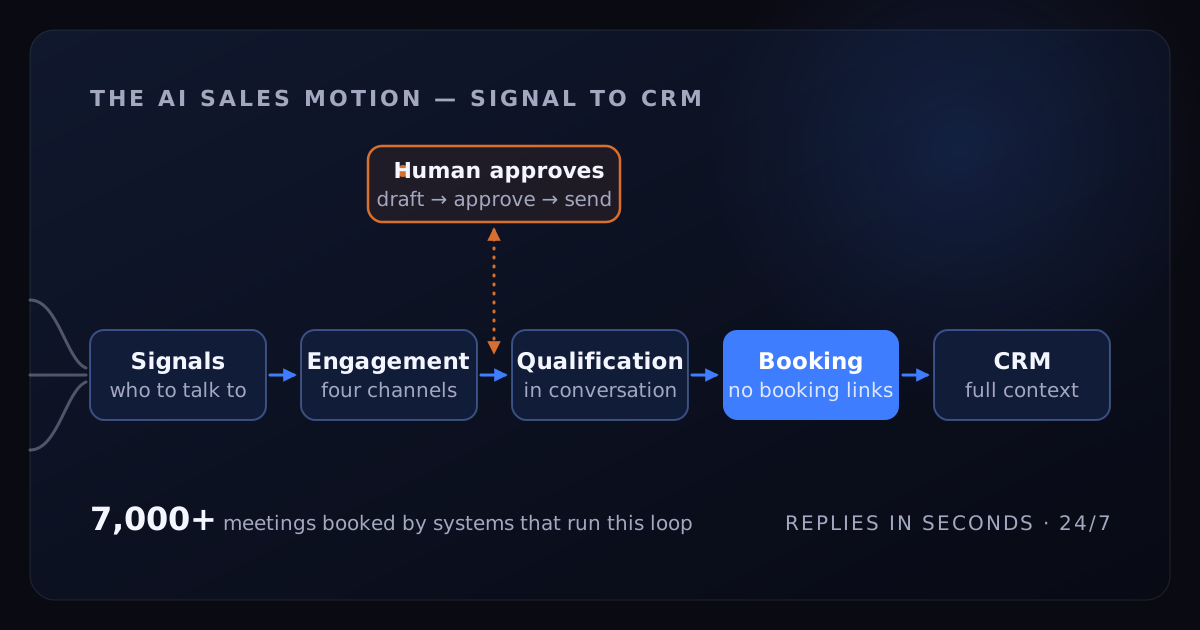
Engagement is where AI's speed does the most damage in the wrong hands, so precision matters here more than anywhere. A production system drafts every touch from the signal that triggered it — not from a merge-field template — runs the cadence across LinkedIn, email, voice, and SMS, respects governed daily volumes, and stops the instant a prospect replies. That last behavior is non-negotiable: the reply is where the actual selling starts, and a sequence that keeps firing past a reply is how warm leads get burned. We've published the LinkedIn outreach sequence, from connection request to booked call, that our systems run daily — structure, timing, and the follow-up cadence included.
Speed to lead: the motion with the most brutal math
The InsideSales.com Lead Response Management research — replicated repeatedly since 2007 — found that contacting a lead within five minutes rather than 30 makes you roughly 21x more likely to qualify them, and that the odds of making contact at all drop about 100x between minute five and minute thirty. The Harvard Business Review audit of 2,241 US companies found an average first response of 42 hours; only 37% responded within an hour, and 23% never responded at all. A commonly cited industry figure (Lead Connect) adds the commercial punchline: 78% of buyers go with the vendor that responds first.
Put those together and the conclusion isn't subtle: most companies pay to generate leads, then donate the winnable ones to whoever answers first. And no human team fixes this with effort, because a five-minute SLA held around the clock is a staffing schedule, not a habit — we've broken down what the data says about the 5-minute window and why the failure is structural. In our deployments, replies get answered in seconds, 24/7, on the channel the lead used. Channel matters more than most teams think, too: which channel wins for which lead depends on where the lead came from and how urgent their problem is — SMS open rates around 98% are a widely reported industry figure for a reason, but voice closes loops text can't.
AI lead qualification: in conversation, not forms
Qualification forms are a tax on your best leads: the buyer does data entry so a rep can decide later whether to talk. Qualification in conversation inverts that. The system asks what your best rep would ask — company size, timeline, the problem behind the inquiry — woven into a natural exchange rather than fired as a checklist. By the time a human sees the thread, qualification isn't scheduled; it's done.
Unlike a form, a conversation branches. A pricing objection gets a real answer. A wrong-fit prospect gets a polite, fast exit that costs you nothing. A hot lead gets escalated to a human immediately, with the full thread attached. Forms can't do any of that — they can only get abandoned.
Booking meetings without booking links
Here's where we're deliberately contrarian: no booking links. A link outsources the last, most fragile step of the sale back to the buyer — open the page, scan a grid of slots, do my admin for me. Momentum dies on that page quietly, and nobody logs it as a lost deal.
The alternative: the system reads your reps' actual calendars and offers two or three real times conversationally — "Would Thursday at 2 or Friday at 10 work?" — then confirms, books, handles the reschedule, and chases the no-show. It's the difference between being handed a kiosk and being helped by a person. This motion is the heart of AiDA SDR, and it's how those 7,000+ meetings got onto calendars.
Database reactivation: the pipeline you already paid for
The least glamorous motion is often the fastest payback. Your CRM holds hundreds or thousands of people who raised a hand once — quoted, demoed, went dark — and you already paid to acquire every one of them. AI re-opens those conversations individually and at scale, referencing the actual history instead of blasting "just checking in." When our customer Junk-A-Haulics ran this as a database reactivation campaign, it produced leads at 5x lower cost than their paid channels — same database, no new ad spend.
Two cautions. Consent rules apply to SMS and voice re-engagement, so verify what each contact opted into before the system dials or texts. And hygiene comes first: reviving a dirty list at machine speed just gets you unsubscribed at machine speed.
What AI still can't do (don't let a demo convince you otherwise)
This section is the reason to trust the rest of the guide. Vendors demo the ceiling; operators live at the median. Here is where AI in sales genuinely stops in 2026:
- It can't fix a bad offer. AI scales your message. If the message doesn't convert at human volume, automating it produces rejection with better uptime. Positioning first, then automation — in that order, always.
- It can't create demand. Signal-driven systems find buyers who are already moving. If nobody in your market is moving, no software invents intent — that's a marketing problem wearing a sales costume.
- It can't run a complex close. Multi-stakeholder discovery, navigating a buying committee, pricing a six-figure renewal — human work, and likely to stay that way for years. The AI's job is to keep that human's calendar full of the right conversations.
- It can't own the relationship. The system earns the meeting; the human earns the deal. Anyone who tells you otherwise is selling something that hasn't survived a renewal conversation.
- It can't clean your data by wishing. Wrong titles, dead domains, duplicate accounts poison every downstream decision the system makes. Budget for hygiene before launch, not after the first embarrassing send.
- It can't be accountable. A pipeline number needs an owner with a name. You can delegate the motion; you can't delegate the miss.
How to implement AI in sales: 30 days to live pipeline, 90 to earned autonomy
Two timelines float around this space — "live in 30 days" and "the 90-day rollout" — and they're the same plan viewed honestly. Weeks 1–4 get you live: train, build, launch, with pipeline flowing in under 30 days. Days 31–90 are the compounding phase, where the system earns autonomy on the motions it has proven. The 90-day frame is a 30-day launch plus 60 days of compounding — not 90 days of waiting for value.
- Weeks 1–2 — train. The system learns your voice from real conversations, your ICP, your objection answers, your written qualification bar. Whatever is vague here compounds later, which is why this is the phase where founders should personally show up.
- Weeks 2–3 — build. Channels connected — LinkedIn, email, voice, and SMS — CRM sync live, signals configured, sending reputation prepared. Boring, load-bearing work.
- Week 4 — launch in draft-for-approval. The AI writes; a human approves every send. First conversations start, first meetings land. The approvals feel tedious for exactly as long as they should: every edit is training data.
- Days 31–60 — earned autonomy. Motions with clean track records graduate to sending unsupervised within governed daily volumes. Edge cases still route to humans, every time.
- Days 61–90 — autonomous with guardrails. The system runs its motions end to end. Humans review transcript samples weekly, keep a kill switch within reach, and spend the recovered hours in the meetings the system booked.
The week-by-week version — with gates and exit criteria for every phase — is in the 90-day AI SDR implementation plan.
Autonomy is earned, not configured
Draft-and-approve isn't a compliance ritual — it's how the system converges on your voice, and how you build justified trust instead of hope. Within a few weeks, most teams find they're approving the overwhelming majority of drafts unchanged. That's the signal to loosen the leash, motion by motion — not everywhere at once, and never because a calendar said so. The full approval-mode playbook, including the tiers between "AI drafts everything" and "AI sends everything," is in human-in-the-loop AI sales: when the AI should draft, not send.
Measuring it: the three numbers that matter
The fastest way to fail with AI in sales is to measure it like a human team. Activity metrics — sends, touches, connection requests — were always weak proxies. Once a machine does the sending, volume costs nothing, and a metric that costs nothing measures nothing. Three numbers survive contact with reality:
- Cost per qualified meeting. Fully loaded system cost divided by meetings that met your written qualification bar. Compare against your human baseline honestly — salary, tools, management overhead, and ramp months included. This is the number your CFO will eventually ask for; have it before they ask.
- Speed to first response. Measure it empirically, not from a dashboard: submit an inquiry to your own funnel at 9pm on a weeknight and time the reply. Whatever number you get is the one every after-hours lead experiences.
- Reply-to-meeting conversion. The purest quality signal in the stack. If replies are up and meetings aren't, the conversations aren't landing — fix messaging or qualification logic before touching volume, because scaling a leaky funnel just buys leaks faster.
What good looks like: Dennis Meador's Legal Podcast Network went from sub-10 leads a month to 10 leads a day, and 50% of their deals now come from AiDA. The instructive part isn't the multiple — it's which number changed. Deals. Not activity.
Buy vs. build vs. hire: the honest math
Every team lands on one of three paths, and each is right for somebody.
Hire another SDR when your deals need deep domain fluency from the very first touch and your volume is low enough that one person can cover it. But do the math honestly: a workweek covers about a quarter of the hours in a week, ramp takes months, and when the rep leaves, everything they learned walks out with them. You're renting capacity, not building an asset.
Build your own stack if you have genuine RevOps engineering capacity and want maximal control. It's a real option in 2026 — we've mapped the best AI sales tools, layer by layer, if you're going this route. Price the integration and maintenance tax honestly, though: the stack is never done, every vendor API changes on its own schedule, and the person who assembled it becomes a single point of failure.
Buy an operated system when you want the outcome without becoming a systems integrator — how we structure operated deployments is the shape we obviously believe in. One warning that applies to all three paths: own the assets. Your domains, your data, your prompts, your conversation history — the case for owning your outbound is that the vendor relationship should be replaceable even if you never replace it. And whatever you buy, prefer systems over campaigns: campaigns expire and systems compound, which is the entire economic argument for sales infrastructure in the first place.
The honest caveat: if inbound already fills your calendar, or your ACV can't support any acquisition cost, you may not need any of this yet. The most expensive AI system is the one bought before the offer works.
Failure modes we see in real deployments
None of these are hypothetical. Each one comes from a real deployment — ours or one we were called in to fix.
- Autonomy on day one. Skipping draft mode because the demo looked ready. The system sends confidently in a voice that isn't yours yet, and you find out from a prospect's screenshot. The first few hundred approvals are the training set; skipping them doesn't skip the learning, it just moves it into production.
- Scaling a message that never worked. If humans got no replies with the pitch, the machine gets no replies faster. Automation amplifies signal and noise with perfect indifference — prove conversion at small volume first.
- No escalation path. A hot prospect asks a hard technical question, and the AI does its polite best while the closer who would have won the deal sits five feet away, unaware. Every deployment needs tripwires: defined intents that route to a human immediately, with the full thread attached.
- Set-and-forget. Autonomy without transcript review drifts — slowly, then embarrassingly. The teams that win read a sample of real conversations every week and feed the misses back in. Twenty minutes, standing meeting, no exceptions.
- Measuring activity. Congratulating the machine on volume is like congratulating your dishwasher on water usage. Meetings, cost per meeting, and conversion — nothing else goes on the scoreboard.
- The Frankenstack nobody owns. Seven tools, four vendors, one automation account nobody remembers the login for. It breaks silently, and the pipeline gap surfaces six weeks later in a board deck. If you build, name an owner. If you can't name one, buy.
The pattern across all six: the failures are governance failures, not model failures. The AI did what it was told. The telling was the problem — which should be genuinely encouraging, because governance is fixable by Tuesday.
Start with one motion. Prove the number against your baseline. Expand only what earned it. That sequence has never once embarrassed anyone who followed it.
Frequently asked questions
What is AI in sales?
AI in sales is the use of AI systems to run or assist the motions that create pipeline — watching buying signals, engaging prospects, responding to inbound leads, qualifying in conversation, and booking meetings. The distinction that matters is assist versus autonomous: assist tools help a rep work faster, while autonomous systems execute the motion themselves under human oversight. Most of the value in 2026 sits in the autonomous category — and most of the content online only describes the assist category.
Will AI replace salespeople?
AI replaces tasks, not the role. Prospecting research, first touches, follow-up, and scheduling admin get automated first, which shifts human time toward discovery, relationships, and closing — the work that actually needs judgment. The reps at risk are the ones whose entire job is the automatable layer; the reps who benefit are the ones who let the system feed them qualified conversations.
How do I start using AI in my sales process?
Start with one motion where speed matters more than craft — inbound speed to lead or database reactivation are the usual first wins. Run it in draft-for-approval mode for the first weeks, measure cost per booked meeting against your current baseline, and expand autonomy only as the transcripts prove out. A focused rollout produces live pipeline in under 30 days; trying to automate everything at once produces a stalled project.
Can AI actually book sales meetings on its own?
Yes — production systems qualify leads in conversation, handle common objections, and book by offering real calendar times conversationally rather than sending a booking link. The systems we run have booked 7,000+ meetings this way across LinkedIn, email, voice, and SMS. The caveat: this is earned behavior, not day-one behavior — autonomy should follow a supervised draft-for-approval period, not precede it.
What's the difference between an AI sales assistant and an AI SDR?
An AI sales assistant helps a human do their job — drafting emails, taking notes, summarizing calls inside a CRM. An AI SDR is infrastructure that runs the motion end to end: it watches signals, engages prospects, qualifies in conversation, and books meetings, with humans supervising through approval modes. If a person still has to drive every step, you bought an assistant, whatever the label says.
How do you measure ROI on AI in sales?
Track three numbers against your human baseline: cost per qualified meeting, speed to first response, and reply-to-meeting conversion. Ignore activity metrics like sends and touches — volume is trivially cheap for a machine, so it no longer measures anything. As a reference point, our customer Junk-A-Haulics saw 5x lower lead cost from a database reactivation campaign than from their paid channels.