Ask ten vendors what a LinkedIn outreach sequence is and you'll get ten screenshots of a flowchart. What you won't get is the part that matters: what each message actually says, how long to wait between touches, and what happens the second someone replies. Vendors sell activity. We install systems — so here's the full anatomy of the sequence our AI agents run every day, example messages included.
None of this is theory. The systems we run have booked 7,000+ meetings across LinkedIn, email, voice, and SMS — this is the LinkedIn playbook inside them. Every stage respects two things most outbound ignores: the prospect's attention and the sender's account.
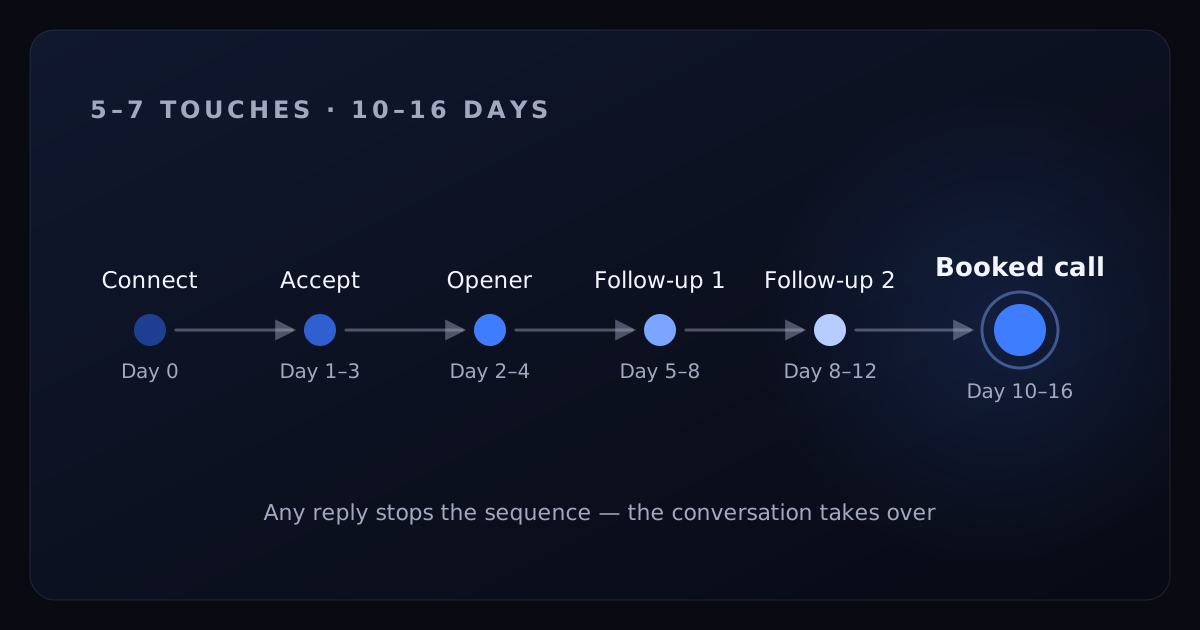
- A working LinkedIn outreach sequence is 5–7 touches over 10–16 days, spaced 2–4 business days apart.
- The connection request has one job — get accepted. If the note would be generic, send it blank.
- Every follow-up must add something new: a proof point, a relevant signal, a sharper question. "Just bumping this" is a vote against yourself.
- The sequence stops the instant someone replies — meetings get booked in the conversation, answered in seconds, closed with real calendar times, never a booking link.
- Benchmarks we consider strong: 65%+ acceptance on well-targeted requests, 35%+ replies on accepted connections, 15–20% of conversations to booked calls.
The sequence at a glance: timing and touch count
A working sequence is 5–7 touches over 10–16 days. Fewer under-touches — one message and a prayer. More, compressed tighter, reads as spam and gets reported. Between touches: 2–4 business days, stretching slightly longer as the sequence ages.
One rule outranks every number in this table: the sequence stops the instant a prospect replies. From that second it's a conversation, not a cadence — handled in seconds, not on tomorrow's task list.
| Stage | Wait | Purpose |
|---|---|---|
| Profile visit or post engagement (optional) | 1–2 days before the request | Warm the name before it shows up in their invites |
| Connection request | Day 0 | Earn the accept. Nothing else. |
| Opener | Within 24–48 hours of acceptance | Start a conversation while attention is warmest |
| Follow-up 1 | 2–4 business days after the opener | Add a proof point or a relevant signal |
| Follow-up 2 | 2–4 business days later | Change the angle; ask a sharper question |
| Follow-up 3 (optional) | 3–5 business days later | Close gracefully; leave the door open |
| Withdraw pending request | After 2–3 weeks unanswered | Protect acceptance rate; recycle capacity |
| Any reply, any stage | Instantly | Sequence stops; the conversation takes over |
The examples below are skeletons of real messages, lightly disguised. Steal the structure, not the words — a copied line dies the moment a prospect has seen it twice; a copied structure doesn't.
Stage 1: the connection request message
The connection request has one job — get accepted. It is not a pitch. It is not a "quick question." It is a short, specific reason for this person to let you into their network.
Two schools of thought exist, and both are right in context. A blank request works surprisingly well with senior buyers who accept based on your profile, not your note — and it can't say anything wrong. A note works better when there's a real hook: a shared context, a trigger event, something specific about their company. The rule we run: if the note would be generic, send blank. A generic note is worse than no note, because it signals automation before the conversation even starts.
A note, when we write one, is one or two sentences inside LinkedIn's roughly 300-character limit, names something true and specific, and asks for nothing. No pitch, no link, no "would love to explore synergies." The pitch-in-the-request is the fastest way to get ignored — or reported.
Stage 2: the acceptance window and the opener
The first 24–48 hours after someone accepts is the warmest moment in the sequence. They just looked at your profile. They said yes to you. Most senders torch it by dumping a five-paragraph pitch into the DMs — the digital equivalent of shaking someone's hand and reading them a brochure.
The right move is a value-first opener. Thank them briefly, then lead with something genuinely relevant: a trigger you noticed (they're hiring for a role you support, they just raised, they changed their stack), a sharp question about a problem their role owns, or a proof point that maps to their situation. One idea, a few sentences, easy to reply to.
The test for a good opener: could they reply to it in one line without feeling like they've entered a sales process? If yes, you've started a conversation. If no, you've started a pitch, and pitches get archived.
Stage 3: the follow-up sequence — add, never bump
Most prospects don't reply to the first message, and that's fine — silence is usually timing, not rejection. What separates a professional LinkedIn follow-up sequence from spam is what the follow-ups do.
- Spacing is 2–4 business days, never hours. Multiple touches inside a day reads as desperation. Days of space between messages reads as a busy peer following up.
- Every touch adds something new. A proof point they haven't seen. A relevant trigger — a competitor move, a hiring surge, a funding event in their space. We rank the buying signals that actually predict pipeline elsewhere; the strong ones make follow-ups write themselves.
- Never "just bumping this." "Just floating this to the top of your inbox" adds nothing, asks the prospect to do your job, and quietly tells them the previous message wasn't worth answering either. If a follow-up has nothing new to say, it shouldn't exist.
Three or four value-adding touches over two weeks outperforms eight bumps — in reply rate, and in your standing with the majority who don't reply this quarter but might next.
Every follow-up is a small referendum on whether you're worth talking to. "Just bumping this" votes no on your own behalf.
Stage 4: the not-accepted path
Here's the stage almost nobody designs: what happens when the request just sits there. Pending requests aren't neutral — a large pile of ignored invitations tells the platform, and anyone who looks, that you're spraying.
The system withdraws pending requests after two to three weeks and recycles that capacity toward fresh prospects. It keeps the sender's acceptance rate healthy, which protects the account; it's simply polite — a withdrawn request disappears, a stale one lingers like an unanswered handshake; and it keeps daily capacity pointed at people who might say yes, not parked against people who already didn't.
Prospects who don't accept aren't burned — they're recycled into other channels or revisited when a real trigger gives you a better reason to reach out. Which channel picks them up is its own decision; we've written up when voice wins and when SMS wins for exactly this handoff.
Stage 5: reply handling — how meetings actually get booked on LinkedIn
Everything above is choreography. This is the performance. A reply on LinkedIn is a live human with your name on their screen, and interest decays by the hour — the same math that makes the first five minutes decisive for inbound leads applies here, one channel over.
Our agents answer in seconds. Not "within one business day." Seconds. The response qualifies naturally: what's driving the interest, what's the situation, is this the right person. When the conversation earns it, the agent offers real open times from the calendar, conversationally.
Why we never send booking links on LinkedIn
A booking link transfers effort from seller to buyer at the exact moment of highest intent. It breaks the conversational frame, adds a click, a page load, a time-zone puzzle, and a decision — and every added step bleeds conversion. The prospect was ready to say yes to a person; the link asks them to say yes to a form.
Offering two or three concrete times is how a human who wants the meeting behaves — so it's how the system behaves. "Would Tuesday at 2 or Wednesday morning work?" keeps the momentum inside the conversation, where the yes already lives. The times are real, pulled live from the rep's calendar, and the meeting is confirmed in the same thread it was earned in — a stance we hold on every channel the system touches.
What a good LinkedIn outreach reply rate looks like
Outbound benchmarks are mostly folklore, so here's the honest version: these are the numbers we consider strong from operating these sequences daily — not industry averages, not promises. They assume a well-targeted list, signal-timed outreach, and replies answered in minutes.
Miss those numbers and the diagnosis is usually upstream. Low acceptance: targeting or the note. Low replies: an opener that pitches instead of conversing. Stalled conversations: response time, or an ask that arrived before it was earned.
The lever under all three numbers is personalization that actually scales. Not {first_name} — everyone's spam filter, human and algorithmic, learned that trick years ago. The formula that holds up at volume is role + trigger + specific observation: who this person is, what just changed in their world, and one concrete detail that proves a human-quality read. That's what our agents compose per prospect — the same engine behind the AiDA SDR system, and how Dennis Meador's team at Legal Podcast Network went from sub-10 leads a month to 10 leads a day, with 50% of their deals now coming from AiDA.
InMail, Sales Navigator, and open profiles
Two variants come up in every conversation about LinkedIn sales sequences. InMail skips the connection step — paid, delivered to people who haven't accepted you, and landing in a folder trained by years of recruiter spam. We reserve it for time-sensitive, signal-timed messages where waiting on an accept would waste the trigger, and for open profiles, which can be InMailed without spending credits.
Sales Navigator isn't a different sequence; it's a better targeting layer for the same one — sharper filters, cleaner lists, more visible triggers. Whatever feeds the top of the funnel, the anatomy holds: value first, days between touches, a reply stops everything.
The safety rail under all of it: governed volume
None of this matters if the account sending it gets restricted. LinkedIn rewards restraint — accounts that behave like people keep their reach; accounts that behave like scripts lose it.
So the whole sequence runs inside governed volumes: conservative daily caps, human-like pacing, activity distributed across the day instead of firing in bursts at 9:00am sharp. We won't quote hard caps — the honest answer is "it depends on the account's age, activity history, and network" — but the principle holds: the sender's account is an asset, and no single day's outreach is worth risking it. It's the same governance layer that decides when the AI should draft for approval instead of sending. Restraint compounds; restrictions don't.
The skeleton and the conversation
Here's the truth under all of this: the sequence doesn't book meetings. The sequence gets you to a reply. The conversation — answered in seconds, qualified with real questions, closed with real open times — is where the meeting happens. Most tools optimize the skeleton and abandon the conversation.
Build both, govern the volume, and the sequence stops being a campaign that expires and becomes infrastructure that compounds. The calendar takes care of itself.
Frequently asked questions
How many messages should a LinkedIn sequence have?
Five to seven touches over 10–16 days: one or two warm-up touches (a profile visit, a post engagement), a connection request, an opener, and two or three value-adding follow-ups spaced 2–4 business days apart. Fewer than that under-touches; more, compressed tighter, reads as spam. The follow-ups — not message one — do most of the booking.
What should a LinkedIn connection request say?
One or two sentences that name something true and specific about the prospect — a trigger event, a shared context — and ask for nothing. Never pitch in the request; it is the fastest way to get ignored or reported. And if the note would be generic, send the request blank: a blank request outperforms a generic note.
How long should you wait between LinkedIn follow-ups?
Two to four business days between touches, stretching slightly longer late in the sequence. Multiple messages inside a day reads as desperation; days of space reads as a busy peer following up. The moment a prospect replies, every scheduled touch stops and the conversation takes over.
What is a good reply rate for LinkedIn outreach?
From operating these sequences daily, we consider 35%+ replies on accepted connections strong, on top of 65%+ acceptance on well-targeted requests, with 15–20% of conversations converting to booked calls. Those numbers assume signal-timed targeting and replies answered in minutes, not days.
Should you send a booking link on LinkedIn?
No — offer two or three real calendar times conversationally instead. A booking link transfers effort to the buyer at the moment of highest intent, and every added click bleeds conversion. “Would Tuesday at 2 or Wednesday morning work?” books more meetings than a link ever will.