
A lead replies to your email at 9:47 on a Tuesday night. What happens in the next five minutes matters more than everything your team does the following week. That's not a slogan — it's one of the most consistently replicated findings in sales research, and almost every B2B team is on the wrong side of it.
This post collects the speed to lead statistics that actually hold up — the 21x qualification window, the 42-hour average response, the 23% of companies that never respond — with sources you can quote in your next pipeline review. Then the part the stat roundups skip: why human teams structurally can't close the gap with effort, and what instant response looks like when it's engineered rather than hoped for.
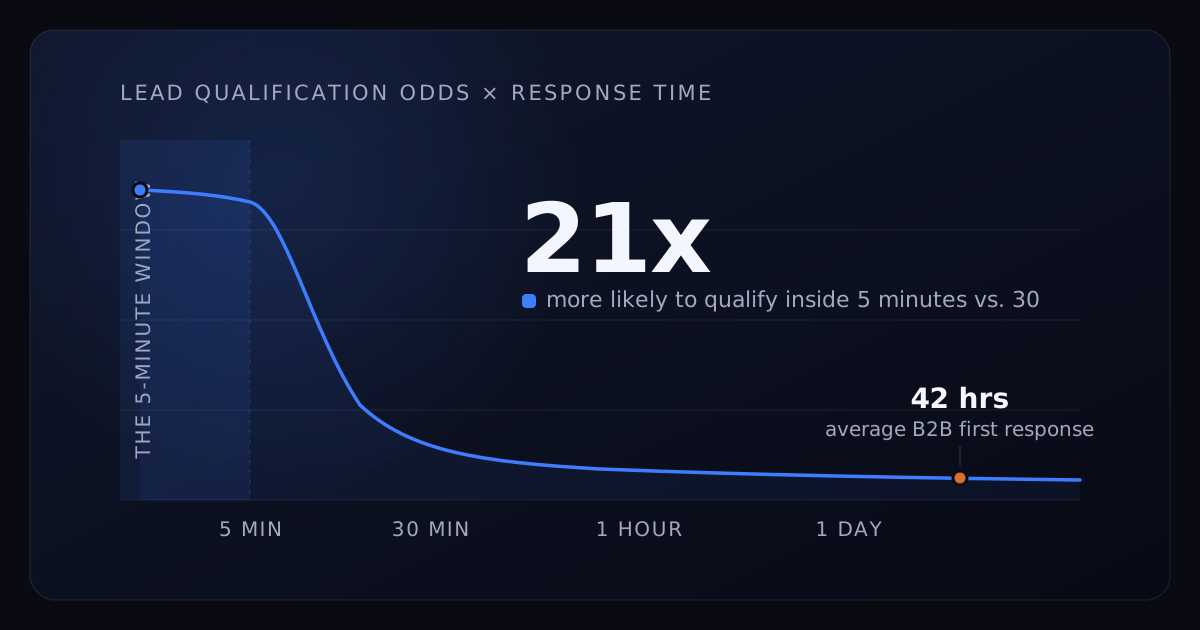
- Contacting a lead within 5 minutes makes you ~21x more likely to qualify them than waiting 30 minutes — and the odds of reaching them at all drop ~100x over the same window (Lead Response Management study).
- The average B2B first response takes 42 hours. Only 37% of companies respond within an hour; 23% never respond at all (Harvard Business Review audit of 2,241 companies).
- A 5-minute SLA, held 24/7 across four channels, is a staffing problem no sales team is shaped to solve. Speed to lead is a coverage problem, not an effort problem.
- An instant reply only captures the window if it qualifies, handles objections, and offers real calendar times. An autoresponder is a receipt, not a response.
The speed to lead statistics that matter
Two bodies of research anchor every credible lead response time claim. The first is the InsideSales.com Lead Response Management study — first published in 2007 and replicated so often since that its core finding is close to a law of the field. The second is the lead-response audit published in Harvard Business Review, which timed how 2,241 US companies responded to a web lead.
| Statistic | Value | Source |
|---|---|---|
| Odds of qualifying a lead, contact within 5 minutes vs. 30 minutes | ~21x higher | InsideSales.com Lead Response Management study |
| Odds of making contact at all, minute 5 vs. minute 30 | ~100x drop | Same study |
| Average B2B first response time | 42 hours | Harvard Business Review audit (2,241 US companies) |
| Companies that responded within one hour | 37% | Harvard Business Review audit |
| Companies that never responded | 23% | Harvard Business Review audit |
| Buyers who go with the vendor that responds first | 78% | Commonly cited industry figure (Lead Connect) — treat as directional |
A note on rigor, because a stats page earns its keep by what it refuses to print: vendor roundups are full of enormous conversion multiples with no traceable study behind them. We're not citing those. The figures above have named sources and years of replication behind them — and they're enough.
Why the 5-minute rule works: interest is a state, not a trait
The person who filled out your form is at their desk, thinking about the problem, right now. Five minutes later they're in a meeting. That evening they're comparing your competitor. The lead didn't get worse — the moment ended.
That's the whole mechanism behind the 5-minute rule for lead response: fast companies win because they reach buyers while intent is still live, not because speed impresses anyone. After a few hours you're not following up on a hot lead — you're cold-calling someone who vaguely remembers your website.
It also explains the most quoted figure in the category: that 78% of buyers go with the vendor that responds first. Hold the precision loosely — it traces to Lead Connect and gets repeated more than it gets audited — but the direction matches everything we see operationally. The first real response frames the conversation and often books the meeting before responder number two has opened the notification.
Average lead response time: the 42-hour reality
Now hold that window against reality. The HBR audit found the average first response to a web lead took 42 hours. Only 37% of companies responded within an hour. And 23% — nearly one in four — never responded at all, to a lead they had paid real money to generate.
Sit with that gap. The window that decides qualification odds is five minutes. The typical response arrives nearly two days later. Most B2B companies are paying acquisition costs for leads and then donating the winnable ones to whichever competitor answers first.
Notice what the 37%-within-an-hour figure rules out: this is not a nights-and-weekends problem. Most companies miss the window at 2pm on a Tuesday with a full team online. That's also why the opportunity is still open in 2026 — the window stays winnable because holding it is structurally hard, and structural problems don't yield to reminders.
Why human teams can't hold a 5-minute SLA
Every sales leader who sees this data has the same first instinct: tighten the process. Slack alerts, response-time dashboards, a "speed to lead" slide at the kickoff. It works for about two weeks.
The reason isn't effort or attitude. A 5-minute SLA, held 24/7, is structurally incompatible with how humans work:
- Meetings. Your reps spend a large share of the working day in calls — which is where you want them. Every one of those hours is a closed response window.
- Nights and weekends. A workweek covers roughly 40 of the 168 hours in a week — under a quarter. Leads don't check your business hours before getting interested, and the ones researching at 11pm are often your most serious buyers.
- Inbox triage. A reply from a hot lead lands between an internal thread, a newsletter, and a calendar notification. A human has to notice it, recognize it, and context-switch to it. That alone routinely eats the window.
- Channel sprawl. The reply can arrive on LinkedIn, email, voice, or SMS — each with its own inbox, notification path, and etiquette. (Voice and SMS behave differently enough under a speed SLA that we compared them head to head.)
Now run the actual coverage math, because this is where the SLA dies. Holding five minutes around the clock on one channel means eyes on that channel every one of the week's 168 hours. After nights, weekends, PTO, and the fact that humans occasionally eat lunch, that's a rotation of four to five people — per channel. Multiply by four channels and you're staffing a small call center whose only job is watching inboxes, before anyone does any actual selling. That's a shift schedule, not a habit. Nobody staffs an SDR team like a fire station.
This is the part worth internalizing: your team isn't failing the SLA. The SLA is impossible for the org shape you have, and no amount of coaching changes that. You can't manage your way out of a structural problem.
Worse, the leads you lose to slow response are invisible. They don't complain — they just book with whoever answered first, and your CRM quietly files them under "no response" or "went dark." The cost never shows up as a line item, which is exactly why it survives every pipeline review.
Speed to lead is not an effort problem, and it can't be fixed with one more dashboard. It's a coverage problem — and coverage is something you build, not something you demand.
What instant response looks like done right
The obvious fix — instant automation — has an obvious failure mode. Everyone has received the autoresponder that answers in one second and says nothing: "Thanks for reaching out! Someone will be in touch." That's not speed to lead. That's a receipt.
An instant response only captures the window if it does the job a great SDR would do in that moment. In the deployments we run, that means the reply that goes out in seconds actually moves the conversation:
It qualifies in the conversation
The response engages with what the lead said and asks the questions your best rep would ask — company size, timeline, the problem behind the inquiry. By the time a human looks at the thread, qualification is already done, not scheduled.
It handles objections instead of deflecting them
"Send me pricing," "we already have a vendor," "call me next quarter" — these show up in first replies constantly. The system answers them the way your team trained it to, in your voice, instead of punting to a rep who'll see the message tomorrow.
It books with real times, not a link
No booking links. A link outsources the work back to the buyer — pick a time, fill the form, do my admin for me. Instead the system reads your reps' actual calendars and offers real open times conversationally: "Would Thursday at 2 or Friday at 10 work?" It's the difference between being handed a kiosk and being helped by a person, and it converts accordingly. The same rule anchors our LinkedIn outreach sequence at every stage of the funnel.
It runs with the oversight you choose
Where you want a human check, the system runs in draft-for-approval mode — it writes the response in seconds and a person approves before it sends. Most teams start there and loosen the leash as accuracy proves out; we've written up when the AI should draft rather than send in detail. And when a lead is clearly hot, it doesn't try to be a hero: it warm-transfers the conversation to a closer with full context, the way a great SDR walks a live prospect down the hall.
Lead response time benchmarks: what good looks like
Here's the bar we'd hold any system to — ours included:
- Under 5 minutes to first meaningful response. Meaningful means it qualifies, answers, or advances — a receipt doesn't count, however fast it arrives.
- Every channel. LinkedIn, email, voice, and SMS. A 5-minute email SLA with a two-day LinkedIn blind spot isn't coverage.
- Every hour. 2pm Tuesday and 2am Sunday get the same response at the same quality. Your competitors are slow even during business hours; nights and weekends are where the gap becomes a moat.
- Synced, not siloed. Every touch lands in the CRM with full context, so the human who takes over sees the whole thread.
In the AI SDR deployments we run, replies get answered in seconds, around the clock — that coverage is a large part of how these systems have booked 7,000+ meetings. And when the winnable leads actually get won, the acquisition math moves: Junk-A-Haulics saw 5x lower lead cost on a database-reactivation program where every response landed in seconds instead of shifts.
Speed is a systems property
Here's the reframe that matters. Response time isn't a performance metric you push on people — it's a property of the system you've built, the way uptime is a property of infrastructure. A team of humans checking inboxes has a structural floor measured in hours. A system that watches every channel and answers in seconds has a structural ceiling of... seconds. Neither number moves with motivation. That's the heart of the argument for sales infrastructure over sales activity: campaigns and pep talks expire, systems compound.
The same lesson applies one step earlier in the funnel, too. The teams that win aren't just faster to respond to interest — they see it sooner, in the buying signals that show up before the form fill. Speed to lead and signal-driven outbound are the same principle at two altitudes: reach the buyer while intent is live.
The research has been public for nearly two decades. The window is five minutes. The average response is still 42 hours — because most companies keep treating a coverage problem as a coaching problem. (For the bigger picture, see our operator's guide to AI in sales.)
Stop asking your team to be faster. Build something that's never slow.
Frequently asked questions
Why does responding within 5 minutes matter?
Contacting a lead within five minutes makes you roughly 21x more likely to qualify them than waiting even 30 minutes, and your odds of making contact at all drop about 100x across that same window, per the InsideSales.com Lead Response Management study. Interest is a state, not a trait: the person who inquired is thinking about the problem right now, and the moment ends fast. A commonly cited industry figure adds that 78% of buyers go with the vendor that responds first.
What is the average lead response time?
Harvard Business Review's audit of 2,241 US companies found an average first response of 42 hours. Only 37% of companies responded within an hour, and 23% never responded at all. The window that decides qualification is five minutes; the typical answer arrives nearly two days later — that gap is the whole speed-to-lead opportunity.
How much does conversion drop after 5 minutes?
The steepest fall happens in the first half hour: between minute 5 and minute 30, the odds of making contact at all drop roughly 100x, and the odds of qualifying the lead drop about 21x. Beyond that, the research and our own operating experience agree directionally: after a few hours you are no longer following up on a hot lead — you are doing cold outreach to someone who vaguely remembers your website.
What is a good speed to lead benchmark?
Under five minutes to a first meaningful response — one that qualifies or advances the conversation — on every channel, 24/7. That is a bar human teams cannot structurally hold, which is why the systems we run answer in seconds instead: the benchmark stops being a stretch goal and becomes a property of the infrastructure.
How do you respond to every lead in under 5 minutes?
You take the human out of the first-touch loop: instant capture of the reply or form fill, and an AI SDR that responds conversationally across LinkedIn, email, voice, and SMS — qualifying, handling objections, and offering two or three real calendar times rather than a booking link. Where you want oversight, it drafts in seconds and a human approves before anything sends.