
Here's a conversation we have more often than we'd like. A company fires their outbound agency after 14 months. They ask for their assets back. The agency sends over a spreadsheet of "contacted leads" and a Google Doc of email copy. That's it. That's what 14 months and six figures bought.
That's sales tech vendor lock-in, and nobody calls it that on the sales call. The domains the outreach ran from? The agency's. The warmed sender accounts with a year of earned reputation? Gone. The reply history — hundreds of real conversations with actual buyers? Locked inside the agency's tooling. The messaging that finally started converting in month nine? Never written down anywhere the client could reach.
They didn't lose a vendor. They lost their entire outbound function, and they're starting from zero — again — with the next one. What follows is that post-mortem turned into a playbook: what to own, what to ask before signing, and how to take it with you when you leave.
- Lock-in in outbound is rarely a contract clause. It's structural: the assets that produce results accumulate in accounts you don't control.
- The one-question vendor filter: "If we fire you tomorrow, what do we keep?"
- Ownership is why outbound compounds. Companies that churn agencies yearly are buying year one, three times.
What sales tech vendor lock-in actually looks like
Most outbound vendors don't set out to hold you hostage. Lock-in is the natural result of how they operate: it's faster to run everything from their own infrastructure. You get a dashboard and a weekly report. Everything that generates the results lives on their side of the fence.
Here's the definition worth keeping. Vendor lock-in is dependency where the switching costs are high enough that leaving means starting over: trapped data, rebuilt sequences, lost history, cold domains. Notice what's absent: a contract. The lock-in that matters is rarely a clause you signed — it's an architecture you didn't inspect.
Which works fine — right up until the relationship ends. And every vendor relationship ends. You outgrow them, they get acquired, quality slips, budgets shift. The question isn't whether you'll separate. It's what you're holding when you do. Under the rental model: almost nothing.
The ownership inventory: who owns your domains, data, and prompts?
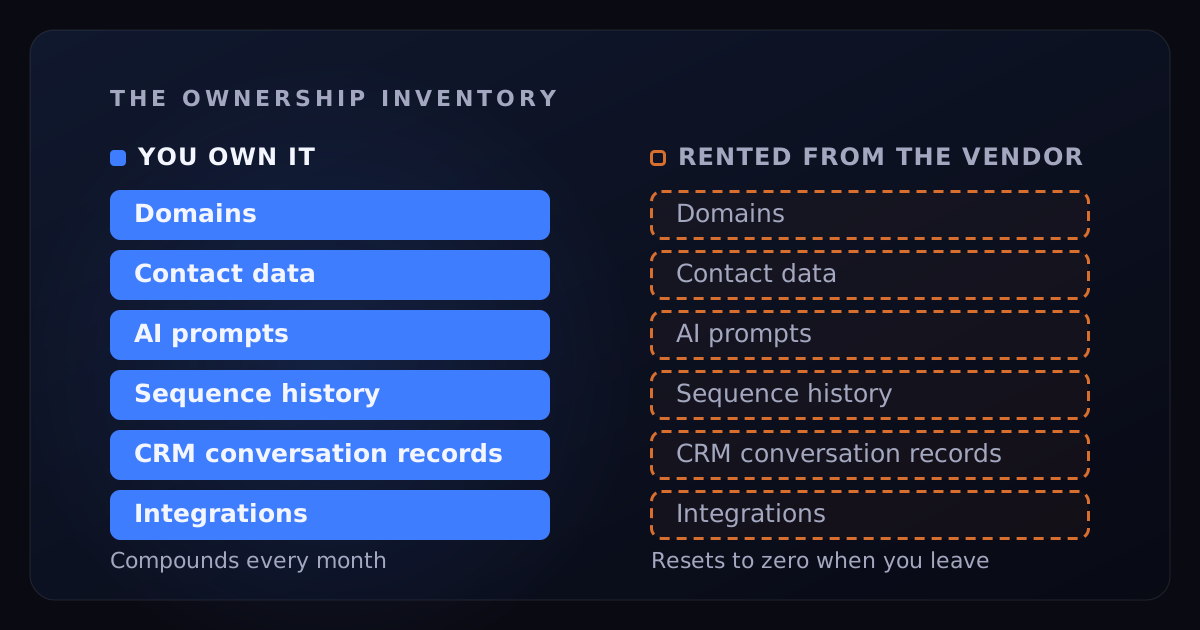
Outbound isn't one asset. It's a stack of them, and each one either compounds in your accounts or evaporates in someone else's. Run any vendor — agency, platform, or AI SDR — against this table.
| Asset | Why it matters | You own it if… |
|---|---|---|
| Sending domains & reputation | Warmed domains that have earned inbox placement are among the few appreciating assets in sales. | Domains are registered in your name, in a registrar account you control. |
| Contact data & enrichment | Lists built against your ICP, verified and enriched — assembled for your market at real cost. | Records live in your CRM, exportable at will, not behind a vendor login. |
| AI prompts & messaging library | Your voice, offers, and objection handling, refined across hundreds of live conversations. | The training exists as documents you can read outside the vendor's platform. |
| Sequence performance history | Which opener works on which title, which follow-up revives dead threads — knowledge paid for in months of live sends. | Per-step performance data exports cleanly, mapped to copy you can see. |
| Conversation records in CRM | Not "contacted 3/12" — the actual threads, readable by whoever runs the account next, human or AI. | Every message, reply, and booking syncs to your CRM in real time. |
| Integrations | The plumbing between CRM, calendars, and channels is where your pipeline actually flows. | Connections are built in your accounts, with your credentials. |
Two rows deserve a note. The prompts row gets missed most and matters most: an AI SDR trained on your business, refined through human-in-the-loop review of real conversations, is intellectual property. If it lives only in the vendor's platform, your voice walks out with them. The sequence-history row is where the expensive knowledge sits: which buying signals actually produce meetings versus polite passes. Losing it means paying for it twice.
Owned contact data has a second life, too: records that go dormant in your CRM can be revived with a database reactivation campaign — an option that only exists when the list lives in your accounts. One of our customers, Junk-A-Haulics, got 5x lower lead cost from a reactivation run on records they already owned.
The "fire us tomorrow" test: what to ask before you sign
You can cut through any vendor's pitch with one question: "If we fire you tomorrow, what do we keep?"
Vendors with nothing to hide have a short, specific answer: here are your domains, your data, your prompts, and the export path for each. Vendors built on lock-in hedge — "we'd work with you on a transition," "some elements are proprietary to our platform," "we'd export what we can."
Ask any vendor what survives the breakup. The honest ones have a short answer. The rest have a paragraph.
The moment of maximum leverage is before the first invoice. After a year of activity flowing through their systems, the switching cost is exactly the hostage value they hold.
Outbound agency vs. in-house: it's the wrong question
Lock-in is why the standard agency-vs-in-house debate goes in circles. Both sides are right about the other's weakness.
Agencies buy speed. A competent one gets meetings flowing in weeks, arriving with working infrastructure and a play they've run before. But under the rental model, everything they learn about your market accrues to them. Fire them in month 14 and you're back at this post's opening anecdote.
In-house compounds — every list, every learning, every warmed domain stays yours. But most teams that build in-house stall on operating discipline, not tooling: daily copy iteration, deliverability monitoring, follow-up that must happen in minutes, not days. Outbound is an operations job that looks like a writing job, and it quietly consumes whichever seller you assign to it.
The resolution isn't picking a side. It's separating two things the debate conflates: who owns the system, and who does the labor. Own the system — domains, data, prompts, history in your accounts. Automate the labor, and hire operators for the judgment. That's the structure behind our 90-day deployment plan: live pipeline in under 30 days, then days 31–90 compounding what the first month learned. Agency speed, in-house ownership.
"We operate it, you own it"
This is the model we run — it's behind the 7,000+ meetings booked on systems we've built — so let me be concrete.
Everything gets built inside accounts you control. The sending domains are registered to you. The AI's training is documented and belongs to you: your ICP, your offers, your objection handling, your voice. Every conversation across all four channels (LinkedIn, email, voice, and SMS) syncs to your CRM in real time. That sync is a core piece of the AiDA SDR system. The signal triggers watching your market — hiring surges, funding events, technology changes, website visitors, new roles and job changes, competitor engagement — feed pipelines in your systems.
We bring the operating layer: deployment, tuning, governed volumes, weekly optimization, and the judgment that comes from many deployments. If we part ways, you keep a running machine and everything it learned. You'd lose us — the operators — not the system. The full model is on our solutions page.
That's a deliberately weaker hostage position than most vendors choose. We're fine with that. A vendor that has to be good to be kept behaves differently than a vendor that's expensive to leave.
How to take it with you: a checklist for switching sales tools
Ownership isn't a feeling; it's a set of artifacts. Items one through five go in the contract before you sign; six through nine are the export run when you actually switch.
- Register the domains yourself, from day one. Sending domains and mailboxes get created in accounts you control, and the contract names you as owner. A vendor who insists on their own domains "for deliverability reasons" is describing the lock-in mechanism, not a technical requirement.
- Put export paths in the contract. Every data type — contacts, enrichment, conversation threads, per-step sequence performance — with a named format, delivered on request, at no fee, within a defined number of days.
- Require the AI's training to exist as documents you can read. ICP definition, offer framing, objection handling, messaging library. "Proprietary configuration" is the polite phrase for "you can't have it."
- Make real-time CRM sync the default, not the exit plan. If every message, reply, and booking lands in your CRM as it happens, the most valuable export is one you never have to run.
- Keep terms short. Month-to-month or quarterly. A vendor confident in their work doesn't need a multi-year bundle; a multi-year bundle usually prices in the switching cost they intend to build.
- Export the suppression data. Unsubscribes, do-not-contact lists, bounce history. Compliance follows you, and re-mailing people who opted out is how a freshly owned domain gets burned in month one.
- Move domains warm. Transfer registrar control, re-point DNS, and keep low-volume sending running through the transition so a year of reputation doesn't decay while the paperwork clears.
- Take the performance history, not just the copy. Sequence steps without their reply and meeting rates are trivia. Export both together, or capture the reports before access ends.
- Revoke everything on the way out. Vendor seats, OAuth grants, API keys. Ownership includes knowing exactly who can still touch your infrastructure the day after.
Ownership is why the system compounds
The bigger argument for ownership has nothing to do with breakup risk: assets that persist accrue value; rented activity resets to zero. The full version of that argument is in this post's companion piece on sales infrastructure vs. activity — campaigns expire, systems compound. That post is about what the system is; this one is about who owns it. The two fail together: an unowned system is just a long campaign.
A domain warmed for twelve months outperforms one warmed for two. A messaging library refined across hundreds of conversations converts better every quarter. An AI SDR with a year of your reply patterns handles objections a fresh deployment can't.
The Legal Podcast Network came to us at sub-10 leads a month; on owned, compounding infrastructure they went to 10 leads a day, and 50% of their deals now come from AiDA. That curve doesn't survive a rented system — any vendor change would have reset it.
When you rent, every switch is a demolition: new domains, cold reputation, rebuilt lists, retrained messaging, blank conversation history. Companies that churn through outbound agencies every year aren't buying three years of progress — they're buying year one, three times.
Own the machine, hire the operators
None of this is an argument for doing outbound yourself — we covered where self-operating stalls. The mistake isn't hiring help. The mistake is confusing "someone runs it for us" with "someone owns it instead of us."
The right structure is both: infrastructure you own, run by operators who know what to do with it. Specialist speed, compounding assets, no hostage dynamics. If it stops working, you change operators — not everything.
Vendors sell activity. We install systems. The difference shows up on the worst day of the relationship, and that's precisely the day to plan for.
Frequently asked questions
What is vendor lock-in in sales tech?
Vendor lock-in is dependency on a platform or agency where the switching costs — trapped data, rebuilt sequences, lost conversation history, cold sending domains — are high enough that you can't realistically leave. In sales tech it's rarely a contractual trap; it's structural: the vendor runs everything from their own infrastructure, so the assets your results depend on accumulate in accounts you don't control.
What happens to your data when you leave an outbound agency?
In the typical rental model, most of it stays behind. Lists, conversation history, converting messaging, and warmed sending domains usually live in the agency's accounts, so you leave with a spreadsheet and start from zero. That restart — not the retainer — is the real cost of renting outbound. Demand named export paths in the contract before you sign, not during the breakup.
Should you build outbound in-house or use an agency?
It's the wrong binary. Agencies buy speed — meetings in weeks instead of quarters — but the learning accrues to them; in-house learning compounds in your accounts, but most teams stall on operating discipline, not tooling. The resolution is owning the system while automating the labor: infrastructure in your accounts, operators you can swap.
How do you avoid lock-in when buying sales tools?
Demand portability in writing before the first invoice: domains registered to you, real-time CRM sync, exportable lists and conversation history, and AI prompts documented where you can read them. Avoid multi-year bundles that price in the switching cost. Then ask what you keep if you fire them tomorrow — honest vendors have a short, specific answer.