
Every serious buyer of an AI SDR eventually asks the same question, usually in the same words: "What if the AI says something wrong to a real prospect?"
It's the right question. Your prospects don't grade on a curve — one bad message to the wrong account can cost more than a quarter of good ones earned. Any vendor who waves the question away with "the AI is really good" hasn't thought hard enough about your downside.
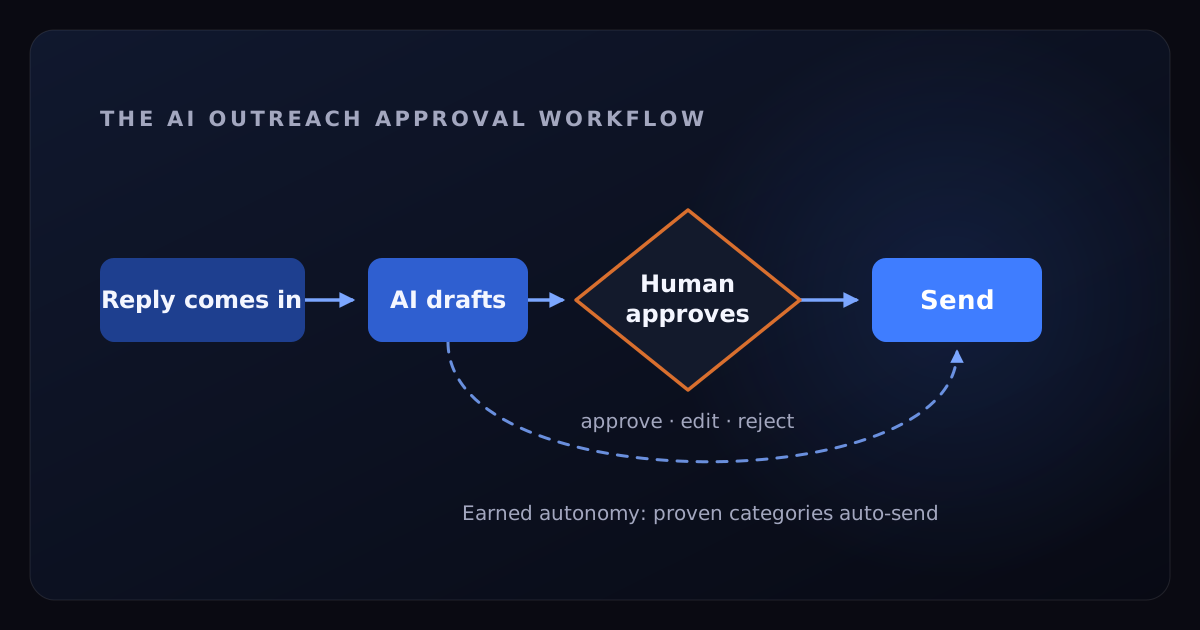
The answer has a name: human-in-the-loop AI sales, and it's simpler than the jargon suggests. The AI does the heavy lifting (reading the reply, researching the account, drafting the response, deciding what's urgent) and a human reviews and approves before anything reaches a prospect. The AI supplies volume and speed. The human supplies judgment and a veto.
But human-in-the-loop isn't one setting. Autonomy is a dial, not a switch. You decide, per conversation type and per account, how much runs on its own and how much waits for a human. What follows: the three positions on the dial, the approval queue up close, and the tradeoff most explainers skip — what review costs you in speed. (Still mapping the category? Start with what an AI sales agent actually does.)
- The AI researches, drafts, and prioritizes; a human approves before anything sends. Autonomy is a dial: draft-for-approval → category autonomy → earned autonomy.
- Within a few weeks, most teams approve the overwhelming majority of drafts unchanged — the signal to move the dial.
- Review everywhere kills speed to lead; tiered autonomy keeps instant response on time-critical replies and human checkpoints on high-risk ones.
- Pricing exceptions, contract language, sensitive accounts, and reputational threads never graduate — they stay human.
Mode one: draft-for-approval
This is where every team starts, and it's exactly what it sounds like. A reply comes in, the AI writes the response it would send: qualified, on-message, in your voice. Then it stops. The draft lands in a queue. A human reads it, edits it if needed, and approves it. Nothing reaches a prospect without eyes on it.
Draft-for-approval does two jobs at once. The obvious one is safety: you have a veto on every message. The less obvious one is calibration. Reviewing drafts is how you learn what the system actually does with your objections, your pricing questions, your edge cases — not what the demo showed, but what happens with your real prospects. Every edit you make is feedback. Every draft you approve untouched is evidence.
Most teams discover something uncomfortable within the first few weeks: they're approving the overwhelming majority of drafts without changing a word. We won't pin a fake-precise percentage on it, but the pattern is consistent enough that we tell buyers to expect it. That's the moment the conversation shifts from "can we trust it?" to "what is the approval step actually buying us here?" — precisely when the dial should move.
Inside the approval queue: approve, edit, or reject
"AI outreach approval workflow" sounds abstract until you've sat in one, so here's the concrete version — how the queue works inside AiDA SDR.
Each item shows the reviewer three things: the prospect's message with the full thread above it, the AI's proposed reply, and the context the AI used — account knowledge, the buying signal that opened the conversation, where the thread stands. You're judging a move in a conversation you can see, not a sentence in a vacuum.
You take one of three actions:
- Approve. The draft sends as written. Once the system has learned your voice, this quickly becomes the most common action.
- Edit. You change the draft, then send. The system logs the gap between what it wrote and what you shipped — its richest training signal.
- Reject. The draft dies, with a reason (usually "this thread needs a human"), and the reason teaches the system its boundaries.
Approvals accumulate as evidence a category is safe to delegate. Edits sharpen tone. Rejections draw the escalation map. The queue isn't a chore bolted onto the AI — it's the mechanism by which the AI becomes yours.
Mode two: category-based autonomy
The next position on the dial isn't "autopilot." It's selective delegation, by category of conversation.
Some replies are routine and low-stakes: "What does your company do?" "How is this different from what we use now?" The system has answered these correctly a hundred times in your approval queue. Letting them auto-send costs you nothing and buys you speed — and replies answered in seconds convert conversations that replies answered tomorrow lose.
Other replies should escalate to a human every single time, no matter how good the AI's track record gets:
- Pricing beyond the published answer — discounts, exceptions, custom terms. Money decisions belong to people with authority over money.
- Legal and contract questions — anything a prospect could later quote back as a commitment.
- The angry prospect — frustration, a complaint, a "take me off your list" with heat behind it. These need human de-escalation, sometimes a human apology.
- Anything ambiguous — when the system isn't confident what's being asked, the right move is to hand it up, not guess.
Category rules give you the shape most teams actually want: a fast lane for the routine majority, a mandatory human checkpoint for everything that isn't. In live deployments the routine share is larger than most sales leaders guess.
Mode three: earned autonomy
The third mode isn't a setting so much as a trajectory. As the system handles real conversations, and its accuracy is proven against your approvals, your edits, your outcomes, the leash loosens. Categories that started as draft-for-approval graduate to auto-send. The approval queue shrinks from "everything" to "exceptions."
The key phrase is at the pace you set. Nothing graduates itself. The evidence accumulates (drafts approved without edits, conversations that became booked meetings, escalations correctly escalated) and you decide when a category has earned its independence. Some teams loosen quickly; some hold full approval for months. Both are correct — the risk tolerance being encoded is yours. And every category keeps a kill switch: one click returns it to draft-for-approval.
This arc is baked into the 90-day AI SDR implementation plan: days 1–30 launch under full review; days 31–90 are where categories graduate on evidence.
Trust in an AI SDR shouldn't be granted on day one or withheld forever. It should be earned in production, one approved draft at a time.
Where humans stay in the loop — permanently
Earned autonomy has a ceiling, and it should. Some categories never graduate, no matter how flawless the track record:
- Pricing exceptions. Not because the AI would botch the math, but because a discount is a business decision, and business decisions carry a name.
- Contract and commitment language. Anything that could bind the company gets a human signature, full stop.
- Sensitive accounts. The strategic logo, the partner's warm intro, the account your CEO personally knows. Some relationships are worth the slower reply.
- Anything reputational. Press adjacency, a public-facing thread, a competitor fishing. When the downside is measured in reputation, not one deal, a human owns it.
This isn't a limitation the system apologizes for. It's the design — and it's why draft-for-approval is standard in every system we install. The point was never to remove human judgment from selling. It was to stop spending human judgment on "yes, we integrate with your CRM" two hundred times a week.
Does human review kill speed to lead?
Now the tradeoff that decides whether governance protects pipeline or quietly costs it: review takes time, and time is exactly what a hot lead punishes.
The numbers are brutal. The InsideSales.com Lead Response Management study, replicated repeatedly since 2007, found that contacting a lead within 5 minutes instead of 30 makes you roughly 21x more likely to qualify. If every reply waits for a reviewer who's in meetings until 3pm, you've bought safety with the very minutes the speed-to-lead data says decide outcomes.
The resolution isn't choosing between oversight and speed. It's tiered autonomy: instant response where timing decides the outcome and risk is low; a human checkpoint where a mistake is expensive and an extra hour changes nothing.
| Tier | What sends itself | What waits for a human |
|---|---|---|
| Tier 1 — full review (launch weeks) | Nothing. Every draft goes to the queue. | Everything — this phase is calibration, not caution theater. |
| Tier 2 — category autonomy | Proven routine replies: info requests, scheduling logistics, standard follow-ups. | Pricing questions, objections with heat, ambiguous asks, any brand-new segment. |
| Tier 3 — earned autonomy | Most conversations — including time-critical inbound replies inside the 5-minute window. | The permanent list: discounts, contract language, sensitive accounts, reputational threads. |
The tiers divide the work cleanly: risk decides what gets reviewed; urgency decides what automates first. A routine scheduling reply from a hot inbound lead should send itself in seconds — it's also where a four-hour delay does the most damage.
The other safety rail: governed volumes
Approval modes govern what gets said. The second rail governs how much and how fast. Every channel the system touches (LinkedIn, email, voice, and SMS) runs under conservative caps and human-like pacing. Activity ramps as results prove out; it never spikes because a machine got enthusiastic. The wait times between touches in the LinkedIn outreach sequence we run are the same idea — governance, not limitation.
The two rails cover different failure modes; you need both. Approval modes protect any single conversation from a bad message. Governed volumes protect your accounts, your domains, and your market's patience from too many messages. A system with perfect copy and reckless volume still burns the asset — it just does it politely.
Why a governed AI is more consistent than a human SDR
Here's the counter-intuitive part, the one prospects push back on until they watch it: a well-governed AI is more consistent than a human SDR — not occasionally, but structurally.
Think about the actual comparison. It's not "AI versus your best rep on their best morning." It's AI versus a tired human at 4:45pm on a Friday, answering their fortieth reply of the week, skipping the qualification question because the weekend is close. Humans have moods, fatigue, and Fridays. A governed system sends its two-hundredth reply with exactly the care of its first — same qualification, same tone, same escalation rules, in seconds, at midnight, on a holiday.
Governance is why it compounds
Vendors sell activity. We install systems — and the difference between campaigns that expire and systems that compound shows up right here. An ungoverned tool gets one bad week and gets unplugged; whatever it learned dies with it. A governed system keeps its checkpoints, keeps earning trust, and keeps running — conversation data accumulates, messaging sharpens, meetings keep landing. That's how you get to 7,000+ booked meetings: not by removing the human from the loop, but by putting the human exactly where the loop needs one.
Governance isn't the thing you tolerate to get the AI. It's the thing that lets the AI stay deployed long enough to compound.
Frequently asked questions
What does human-in-the-loop mean in AI sales?
It means the AI handles research, drafting, and prioritization, while a human reviews and approves messages before they send. It's the governance model that makes AI outreach defensible: every message can be vetoed, and every edit teaches the system. As accuracy is proven, review narrows from everything to exceptions.
When should AI outreach require human approval?
Always during the first weeks of a rollout, and permanently for new segments, sensitive accounts, and anything touching pricing, discounts, or contractual commitments. Routine replies — info requests, scheduling, standard follow-ups — graduate to autonomous sending once the approval record shows the AI handles them cleanly.
Does human review kill speed to lead?
Only if you apply it to everything. The fix is tiered autonomy: time-critical, low-risk replies send instantly, while higher-risk messages wait in the approval queue. That keeps sub-minute response where timing decides outcomes and human judgment where a mistake is expensive.
What is earned autonomy for an AI SDR?
Earned autonomy means the AI starts in draft-for-approval and unlocks autonomous sending category by category as its approval rate and reply quality clear thresholds you set. Nothing graduates itself — the evidence accumulates in your queue and you move the dial. Every category keeps a kill switch that returns it to draft mode instantly.
How do you audit AI-written sales messages?
Sample sent messages weekly against a short checklist: factual accuracy, tone, correct qualification, correct escalation. Track the edit rate — the share of drafts a human changed before sending — as a KPI; it should fall steadily. A rising edit rate in any category is the signal to move it back to draft-for-approval.