Ask five vendors what an AI sales agent is and you'll get the same answer five ways: "software that uses AI to automate sales tasks." True, and useless. It doesn't tell you what the agent does at 2am when a lead replies, what breaks when you hand it too much autonomy, or how to tell a real agent from a sequence tool that changed its label. We operate AI sales agents for a living — the systems we run have booked 7,000+ meetings — so here's the definition we actually work from.
Every clause in that definition is load-bearing, and this post unpacks them one at a time: what the agent actually does all day, how the machinery works underneath, the terminology mess ("agent" vs. "SDR" vs. "chatbot"), where these systems genuinely fail, and the checklist we'd use to evaluate one if we were buying instead of building. It's the definitional piece of our full operator's guide to AI in sales — start here if you're still deciding whether the category is real.
- An AI sales agent runs a loop — watch signals, engage, qualify, book — not a task. A tool that only sends messages is a sequence tool, whatever the pricing page says.
- The language model is the smallest part. Data, channels, and guardrails decide whether an agent produces pipeline or apologies.
- Speed is the core economic argument: the research puts the qualification window at minutes, and the average B2B first response at 42 hours.
- The failure modes are predictable and avoidable: spam-cannon volume, fake personalization, and full autonomy on day one.
- Autonomy should be earned in stages — draft, approve, send — not granted at kickoff.
The definition that survives contact with production
Notice what our definition doesn't say. It doesn't say "automates outreach" — sending messages is the easiest fifth of the job. It doesn't say "engages leads" — engagement is an activity metric, and activity is not the output. The output of a sales agent, human or artificial, is a qualified meeting on a calendar. Everything else is means.
Notice also the last clause: under rules you set. An agent without governance isn't a bolder version of the product; it's a different product, one that generates apologies at machine speed. The rules — who to contact, what to claim, how often to touch, when to stop, when to hand off to a human — are as much a part of the system as the model is. More, actually: when we do the postmortem on a failed deployment, it almost never reads "the AI wrote a bad sentence." It reads "nobody set the rules."
What an AI sales agent is not
The label is doing heavy lifting across the industry right now, so the borders matter. An AI sales agent is not a sequence tool (pre-written touches on a timer, no reasoning between them). It's not a chatbot (a scripted decision tree parked on one channel). And it's not an auto-dialer with a synthetic voice bolted on. All of those can be useful; each is a fraction of the job; and several have quietly relabeled themselves "agents" without changing what they do. The full terminology map is below — including a one-question test that sorts them in about a minute.
What an AI sales agent actually does all day
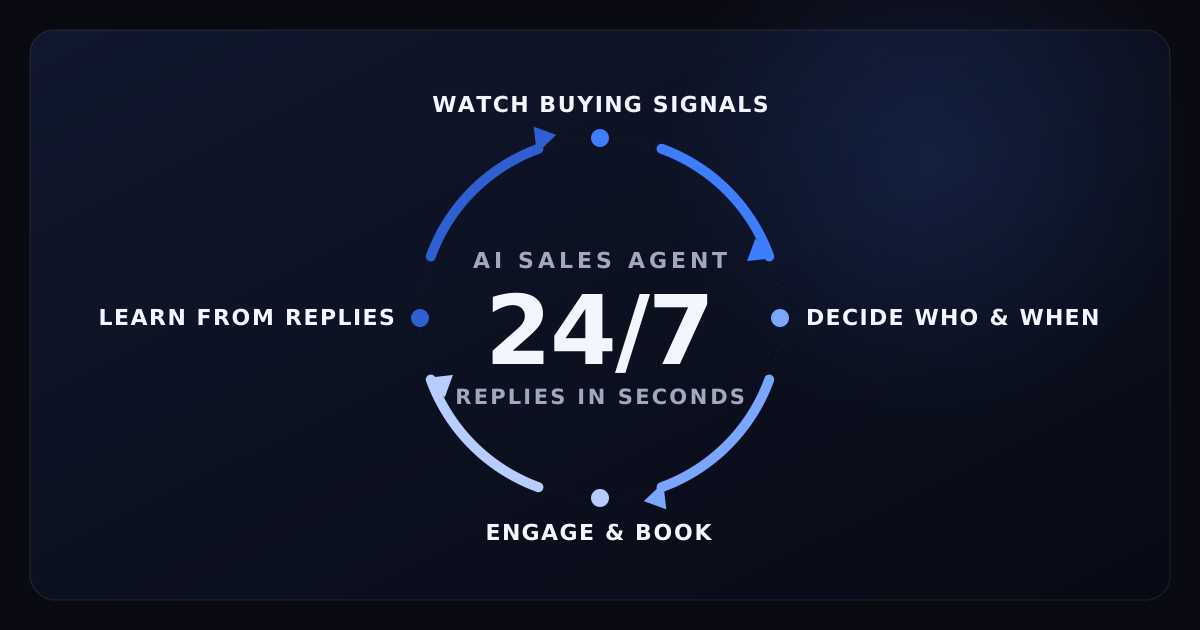
Strip away the branding and a production agent runs one loop, continuously: watch, engage, qualify, book, learn. Here is each stage as it actually operates.
It watches buying signals, not static lists
The agent monitors the market for reasons to reach out. Six signal types cover most of what predicts near-term buying: hiring surges, funding events, technology changes, website visitors, new roles and job changes, and competitor engagement. We ranked them by what converts in the buying signals that actually predict pipeline.
This is the part most AI SDR marketing skips, because it's the unglamorous data-plumbing half of the product. It's also the half that changes results. A message triggered by something that happened this week — a VP of Sales hire, a funding announcement, three visits to your pricing page — starts a different conversation than the four-hundredth email to a scraped list. The signal is the personalization. Everything else is garnish.
It opens conversations that don't read like automation
On outbound, the agent turns a signal into a first touch: a connection request, a short opener, follow-ups spaced the way a disciplined human would space them — across LinkedIn, email, voice, and SMS, depending on where the prospect actually lives. Structure beats cleverness here, and we published the full anatomy of a LinkedIn outreach sequence if you want the message-level detail. The agent's edge isn't better prose. It's that it never forgets a follow-up, never lets a thread die on touch two, and stops instantly the moment a reply arrives.
It answers every reply in seconds — speed to lead is half the job
This is the capability that pays for everything else. The lead-response research is old, replicated, and still ignored: the Lead Response Management study found that contacting a lead within five minutes instead of thirty makes you roughly 21x more likely to qualify them, and the odds of making contact at all drop about 100x between the 5- and 30-minute marks. Meanwhile the Harvard Business Review audit of 2,241 US companies found an average first response time of 42 hours — only 37% responded within an hour, and 23% never responded at all.
A human team structurally cannot hold a five-minute SLA around the clock; we did the coverage math in our breakdown of the 5-minute window. An agent holds it trivially. In the systems we run, replies get answered in seconds, 24/7 — at 2pm on Tuesday and 2am on Sunday, with the same quality. It's also a commonly cited industry figure that 78% of buyers go with the vendor that responds first; treat the precision with suspicion, but the direction matches everything we see in production.
It qualifies in the conversation, not with a form
When a reply lands, the agent does what your best rep would do with unlimited patience: it engages with what the prospect actually said, asks the qualification questions in your playbook — company size, timeline, the problem behind the inquiry — and handles the standard objections ("send me pricing," "we already have a vendor," "call me in Q3") in your voice, immediately. By the time a human looks at the thread, qualification isn't scheduled. It's done, logged to the CRM with full context.
It books by offering real times — never a booking link
Here's where we deviate from nearly every vendor in the category: our agents never send booking links. A booking link outsources the finish line to the buyer — go to my page, scan my calendar, do my admin for me. The agent instead reads the team's actual availability and offers times conversationally: "Would Thursday at 2 or Friday at 10 work?" It's a small mechanical difference that behaves like a large one, because the prospect stays in a conversation instead of being handed a kiosk. The meeting gets confirmed in the thread, the invite goes out, and the handoff to your closer carries the entire exchange.
Underneath all five stages, the loop closes on itself: every reply, objection, and booked (or ghosted) meeting feeds back into what the agent prioritizes and how it drafts. That's the difference between an agent in month three and an agent in week one — and it's why deployment timelines matter, which we'll get to.
AI sales agent vs. AI SDR vs. chatbot: a terminology map
The industry uses these labels interchangeably — often on purpose. Here's the map we'd draw for a buyer:
| Tool type | What it does | What it can't do |
|---|---|---|
| AI sales agent | Watches buying signals, opens and answers conversations across LinkedIn, email, voice, and SMS, qualifies in-thread, books meetings. Reasons about every reply individually | Judgment work: complex negotiation, deal strategy, relationships. Needs governance before it earns trust |
| AI SDR | An AI sales agent scoped to the SDR role — top-of-funnel prospecting, qualification, meeting-setting. In practice the two labels are interchangeable | Everything after the meeting books: discovery to close stays with your closers |
| Chatbot | Follows a scripted decision tree on one channel, usually the website widget | Anything off-script. Can't work other channels, take actions, or reason about intent |
| Sequence tool | Sends pre-written touches on a timer; stops when someone replies | Can't read or answer the reply — a human writes every response. No signal awareness |
| AI dialer | Places or answers phone calls with a synthetic voice against a script | One channel, thin context, and qualification with the depth of a survey |
The one-question test: put an unscripted reply in front of it. Something like "We're locked in with a competitor until March, but the CFO hates their invoicing — worth a conversation in Q2?" A sequence tool marks the thread "replied" and goes quiet. A chatbot offers you three menu options, none of which are about March. An agent answers the actual sentence, notes the date, and proposes the Q2 conversation. If the demo can't survive an unscripted reply, you're looking at a sequence tool with a good publicist.
How AI sales agents work: model, data, channels, guardrails
"How do AI sales agents work" usually gets answered with a paragraph about large language models. But the model is the smallest part of a working system — the commodity part, honestly. Four layers, in ascending order of how often they're the reason a deployment fails:
- The model. A language model drafts messages, interprets replies, and decides the next action. Off the shelf it's fluent and generic. Trained on your ICP, your offer, your objection handling, and your voice, it starts sounding like your best rep on their best day. Of the four layers, this one matters least — every serious vendor runs a frontier model.
- The data layer. Signal feeds, enrichment, and CRM context. This layer decides who gets contacted and why — the difference between "saw you're hiring three SDRs this month" and "I hope this finds you well."
- The channel layer. Real integrations with LinkedIn, email, voice, and SMS, plus the unglamorous machinery that keeps them healthy: send pacing, domain warm-up, deliverability monitoring, per-channel etiquette. This is where spam-cannon deployments die first.
- The guardrail layer. The playbook and the rules: qualification criteria, claims the agent may and may not make, approval gates, stop conditions, suppression lists, escalation to humans. The least-demoed layer, and the one that determines whether you'd let the thing anywhere near your brand.
When an AI sales agent fails in production, it's almost never because the model wrote a bad sentence. It's because nobody set the rules about who to contact, how often, and when to stop.
Where AI sales agents fail: the three modes we keep seeing
We're bullish on this category — we built a company on it — which is exactly why we'd rather name the failure modes than let you discover them. The skeptical write-ups about AI SDRs are easy to find, and the horror stories in them are real. They're just not stories about the technology. They're stories about three specific deployment mistakes.
The spam-cannon trap
The tools make volume nearly free, so the default temptation is to multiply it. Analyses of the category keep reporting the same shape: send volume up several-fold, reply rates down by roughly a third, and churn high enough that a large share of customers don't renew. Deliverability compounds the damage — blast from a domain for a few weeks and the inbox providers quietly stop delivering you, at which point no model can save the program. Volume is not the advantage AI gives you. Coverage and speed are. An agent that sends less, to signal-qualified prospects, and answers instantly will beat a cannon in every quarter we've watched.
Fake personalization buyers can smell
The second failure is scraping a biography and calling it relevance: "Loved your recent post on leadership!" Buyers have inboxes full of this now, and they've developed antibodies — the template is visible from across the room. Real relevance comes from timing, not trivia: something happened at the prospect's company that makes your outreach make sense today. An agent working from real signals doesn't need to fake familiarity, because it has an actual reason to be in the thread.
Full autonomy on day one
The third failure is handing an untrained agent your brand at full send volume from the first week. Day-one autonomy is where the category's worst stories come from — wrong claims, tone-deaf replies to sensitive messages, commitments nobody approved, all multiplied by machine throughput. The fix isn't less AI. It's staged trust, which deserves its own section.
The autonomy ladder: from draft-for-approval to earned autonomy
Autonomy is not a setting. It's a graduation. The deployments that work climb a ladder:
- Draft-only. The agent writes everything; a human sends everything. You're evaluating voice, accuracy, and judgment with zero exposure.
- Draft-for-approval. The agent operates through an approval queue — the draft is ready in seconds, a human taps approve, it sends. Speed is mostly preserved and oversight is total. This is where most teams should start, and in our experience, within a few weeks most are approving the overwhelming majority of drafts unchanged.
- Earned autonomy. Routine motions — first touches, follow-ups, scheduling, standard objections — send themselves inside hard guardrails, category by category, while anything novel, sensitive, or high-value escalates to a human. This rung is reached, not selected.
The interesting design question is which message types sit on which rung: a routine follow-up can go autonomous long before a pricing conversation should. We wrote a full piece on exactly that boundary — when the AI should draft, not send. The short version: the ladder is the point. A vendor that skips it is selling you their risk tolerance instead of yours.
What the numbers look like when it works
These are first-party numbers, so weigh them accordingly — but they're what a signal-first, speed-first, governed deployment produces. The systems we run have booked 7,000+ meetings. Junk-A-Haulics got 5x lower lead cost from a database-reactivation deployment — pipeline built from leads they had already paid for once. Dennis Meador of the Legal Podcast Network went from sub-10 leads a month to 10 leads a day, and 50% of their deals now come from AiDA.
Timeline expectations, stated honestly: a properly run deployment produces live pipeline in under 30 days — weeks one through four are train, build, launch. Days 31 through 90 are the compounding phase, where reply data sharpens the playbook and the agent earns autonomy rung by rung. So when you hear "90 days" from us, that's the composition — a 30-day launch plus 60 days of compounding, not 90 days of waiting. The week-by-week detail is in the 90-day AI SDR implementation plan.
One caveat we'd rather state than have you discover: these numbers come from deployments where the full loop runs end-to-end and a human governs quality — the configuration AiDA SDR operates. An agent bought and run as a volume tool will produce volume-tool numbers, and they will not look like these.
An operator's checklist for evaluating any AI sales agent
Eight questions. Ask them in the demo — the squirming is diagnostic.
- What triggers outreach? If the answer is "you upload a list," you're buying a sequence tool. Ask which buying signals it watches and where the signal data comes from.
- Show me an unscripted reply. Type a messy, multi-part objection into the live demo yourself. Watch whether it answers the sentence or the script.
- What's the response SLA at 2am on a Sunday? Speed to lead is the category's core economic argument. Get the answer in numbers — it should be seconds — and get it into the contract.
- How does it book? If the answer is "it sends your booking link," the last and most valuable step of the loop has been outsourced back to your buyer.
- What are the autonomy modes, and what's the default? There should be a draft-for-approval ladder that graduates to earned autonomy, defaulting low. "Fully autonomous out of the box" is a warning label, not a feature.
- What stops it? Suppression lists, pacing caps, stop conditions, escalation rules. If guardrails don't come up in the first demo, assume they don't exist.
- What do I own when I leave? Conversation history, contact data, the trained playbook. If it all evaporates at cancellation, price that into the decision.
- What's the cost per qualified meeting? Not per seat, not per contact. And ask what happens to the price as your volume scales — that's where the surprises live.
The definition we opened with fits in a sentence, but the substance is in the clauses: signals, seconds, conversation, calendar, rules. Any vendor can say "AI sales agent." The loop is what you're buying — make them show it to you running.
Frequently asked questions
What does an AI sales agent actually do?
It runs a loop: watch buying signals (hiring surges, funding events, technology changes, website visitors, new roles and job changes, competitor engagement), open or answer conversations across LinkedIn, email, voice, and SMS, qualify the prospect inside the conversation, and book the meeting. 'Automates sales tasks' is the brochure version — the loop is the job. In the systems we run, every reply gets answered in seconds, 24/7.
How do AI sales agents work?
A language model drafts messages and interprets replies, but it is the smallest part of the system. The working parts are the data layer (buying signals, enrichment, CRM context), the channel layer (LinkedIn, email, voice, and SMS integrations with pacing and deliverability controls), and the guardrail layer (playbooks, approval gates, stop conditions). Most production failures are guardrail and orchestration failures, not model failures.
Can an AI sales agent replace a human SDR?
It replaces the repetitive layer of the job — first touches, instant replies, follow-ups, qualification, scheduling — not the judgment layer. Complex objections, deal strategy, and relationships stay human. The teams that get the best results run agents under human oversight and expand autonomy gradually as accuracy proves out, rather than choosing between AI and people.
What is the difference between an AI sales agent and a chatbot?
A chatbot follows a scripted decision tree on a single channel, usually your website widget, and breaks the moment a visitor goes off script. An AI sales agent reasons about intent, works across LinkedIn, email, voice, and SMS, and takes actions — enriching a contact, qualifying, offering meeting times — without a pre-drawn flow. The fastest test is to ask each one something it was never scripted for.
Do AI SDRs actually work?
Not as spam cannons — analyses of the category consistently find that multiplying send volume drives reply rates down and burns sending domains, which is why churn among volume-first tools is high. They work when outreach is signal-triggered, inbound response is instant, and a human governs quality until the agent earns autonomy. That configuration is what has booked 7,000+ meetings across the systems we run.
How much does an AI sales agent cost?
Self-serve tools start at a few hundred dollars a month; enterprise platforms often land in the tens of thousands per year, and many vendors do not publish pricing at all. The comparison that matters is cost per qualified meeting — measured against a fully loaded human SDR — not price per seat. Ask what happens to the price as your volume scales; that is where the surprises live.