Most teams evaluating an AI SDR ask the same first question: "How fast can it book meetings?" It's the right question with a wrong assumption baked in — that speed and quality trade off against each other. They don't, if the rollout is sequenced correctly.
This is the AI SDR implementation plan we run inside B2B sales teams — the same sequence every time, because it works. The systems we operate have booked 7,000+ meetings on it, and by now the plan is boringly repeatable. Here's the whole thing: what you need before day one, the steps inside each phase, the gates that decide whether you advance, and the metrics that prove it's working.
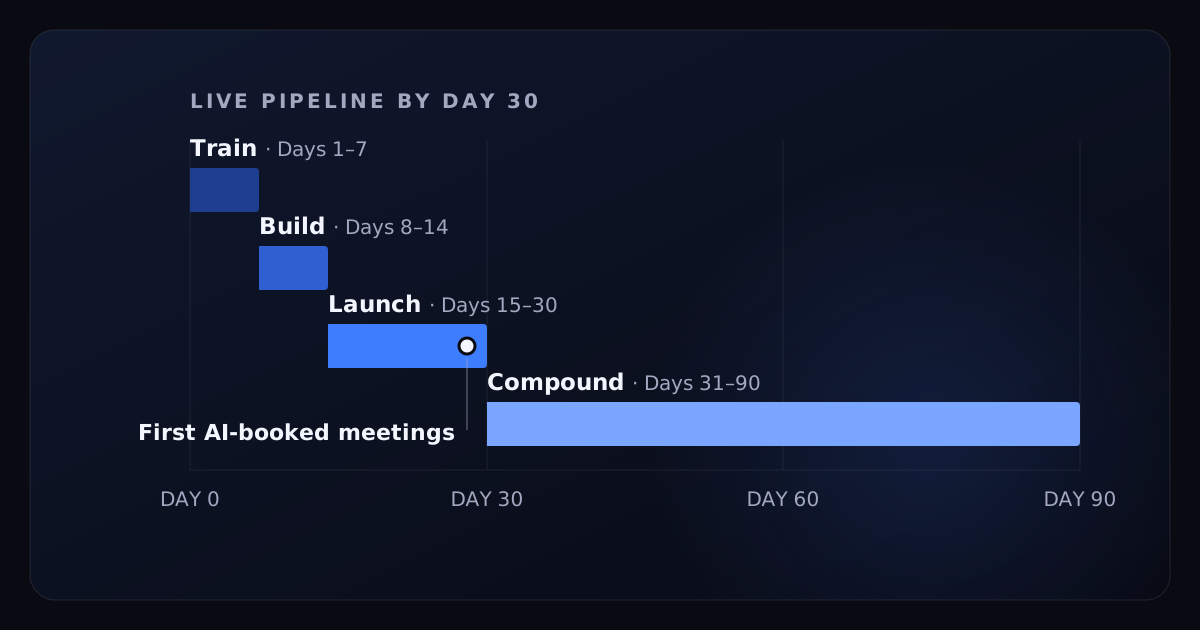
One framing note first, because it trips people up. We tell customers live pipeline in under 30 days, and we mean it: training, build, and launch all happen inside the first four weeks. So why a 90-day plan? Because days 31–90 are a different kind of work — the compounding phase, where messaging converges, targeting sharpens, and the system earns autonomy. The 90-day frame is a 30-day launch plus a 60-day compounding phase. Evaluate only the first 30 days and you'll underprice the entire category, because the second 60 is where the economics leave a human hire behind.
- Live pipeline lands in the first 30 days (train → build → launch); days 31–90 are the compounding phase. The 90-day plan = a 30-day launch + 60 days of compounding.
- Every phase has an exit gate. When a gate fails, fix the input — the ICP, the list, the message — never push volume to compensate.
- The most expensive mistake in the category is sending from cold infrastructure in week one. Deliverability is earned over days, not toggled on.
- Judge the system on reply rate, positive-reply rate, meetings booked, speed to first response, and cost per meeting — never raw sends.
- Autonomy is earned: the AI drafts for approval first and sends on its own only after its accuracy proves out.
What you need before day 1
Deployments stall for exactly one reason: the inputs weren't real. Before kickoff, have six things ready. None requires more than a working session or two.
- A documented ICP. Not "B2B companies, 50–500 employees" — the attributes that actually predict a closed deal: industry, role, tech environment, team structure, and the disqualifiers that waste rep time.
- Your objection list. The eight or ten things prospects actually say — "we already have a vendor," "call me next quarter," "send me pricing" — and how your best rep answers each one.
- Proof mapped to buyers. Case studies and numbers organized by who they persuade. A logo wall isn't proof; "here's what happened for a company like yours" is.
- Calendar and CRM access. The system books meetings by offering real open times from reps' calendars, and every conversation syncs to your CRM. Both connections should exist before outreach does.
- A decision-maker on messaging. Someone who can approve sequences in days, not weeks. Approval lag is the most common self-inflicted delay in this entire plan.
- Reps who show up. The system fills calendars. It can't attend the meeting for you.
The 90-day rollout at a glance
Four phases, each with a hard gate. You don't advance on the calendar — you advance when the gate clears.
| Phase | Days | The work | Gate to advance |
|---|---|---|---|
| Train | 1–7 | ICP, offers, objections, and voice transferred into the system | You read the first drafts and recognize your own voice |
| Build | 8–14 | Domains warming, lists built, signals wired, sequences loaded — zero sends | You approve the list and sequences; warm-up metrics are healthy |
| Launch | 15–30 | Governed volumes go live; every reply answered or drafted in seconds | Live pipeline: real ICP conversations and first AI-booked meetings on calendars, synced to CRM |
| Compound | 31–90 | Weekly variant cuts, targeting refinement, expanding autonomy | Meetings arrive weekly from outbound and signal-triggered sequences; approvals are the exception |
Days 1–7: Train — the system learns your business
An AI SDR is only as good as what it's trained on, so the first week is pure knowledge transfer — moving what your best salesperson knows into the system, in four steps:
- Sharpen the ICP into targeting logic. The document from your readiness checklist becomes rules the system can act on: who gets pursued, who gets skipped, and which disqualifiers end a thread before it wastes anyone's time.
- Load offers and proof. What you sell, how it's priced, which case study maps to which buyer, and the numbers that make a skeptical VP lean in.
- Encode objection handling. Each objection gets a response pattern drawn from how your best rep actually answers it — not a generic rebuttal library.
- Capture your voice. Real emails and messages your team has sent that got replies. The system writes in your register, not a generic "sales-y" one.
Your time cost is a few working sessions. Teams that show up with a real ICP and honest objection lists get to pipeline faster than teams that hand over a brochure.
Days 8–14: Build — infrastructure before outreach
Week two is construction. Nothing goes out the door yet, deliberately:
- Provision sending infrastructure. Dedicated domains and sender accounts, configured in accounts you own, not ours — who owns your outbound assets matters more than most buyers realize. Warm-up begins immediately, because deliverability is earned over days, not toggled on.
- Build the target lists. The ICP becomes named accounts and named people, enriched with verified contact data. You review the first list. If anything looks off, we fix the definition — not the symptom.
- Wire the signal triggers. Hiring surges, funding events, technology changes, website visitors, new roles and job changes, competitor engagement — the buying signals that actually predict pipeline get pointed at your market, so sequences start themselves when something real happens.
- Draft and load sequences. Cadences are written in your voice for the four channels the system works — LinkedIn, email, voice, and SMS — with email and the LinkedIn outreach sequence carrying the first touches. This is where week one pays off — you should read the drafts and think, "that sounds like us on a good day."
The single biggest deployment mistake in this category: sending from cold infrastructure in week one. It feels fast. It burns domains you'll spend months rehabilitating.
Days 15–30: Launch — governed volumes, live replies
Outreach goes live — small on purpose, then scaling. If you're calling this phase an AI SDR pilot, this is what a real one looks like: one segment, conservative volumes that ramp as deliverability and reply quality prove out, and gates you defined before the first send. Two things start happening that deserve close attention.
The inbox comes alive
Replies start arriving, and this is where an AI SDR earns its keep. Every reply gets answered in seconds, 24/7 — qualifying, handling objections, and offering two or three real open times from your reps' calendars, conversationally. No booking links. Response speed decides qualification odds — the five-minute window is the whole argument — and "seconds, around the clock" is a standard no human team can hold.
If you want a human check first, the system runs in draft-for-approval mode instead: it writes every response, a person approves, edits, or rejects, and it learns from each decision. Most teams start with a human in the loop and loosen the leash as they watch it work.
The feedback loop starts
Every conversation is data. Which opener gets replies from CFOs but not CTOs. Which objection stalls deals in your market. Which signal produces meetings versus polite passes. The system adjusts weekly, and you see the reasoning — nothing tunes itself invisibly.
The day-30 gate: live pipeline. Real conversations with real ICP buyers, and your first AI-booked meetings sitting on reps' calendars, synced to your CRM with full context. In practice the first meetings usually land in weeks 3–4, once warm-up clears and the first sequences run their course. If day 30 arrives without them, something upstream is wrong — the list, the message, or the market — and the fix is upstream too. More volume is never the fix.
Days 31–90: Compound — where the math changes
This is the phase most evaluations never model, and it's where the economics of an AI SDR diverge from a human hire. A human SDR at day 60 is still ramping — most teams budget three to six months to full productivity. The system at day 60 has already processed hundreds of conversations and is measurably better than it was at day 30. Three mechanisms drive that:
- Messaging converges on what works. Underperforming variants get cut weekly; winners get more volume. By day 60 you own a library of proven messaging — an asset that keeps appreciating. You're not guessing — you're reading a scoreboard.
- Targeting sharpens. The accounts that reply and book teach the system what your best-fit buyer actually looks like, and that feeds back into list building. The day-75 list is built from evidence the day-10 list couldn't have had.
- Autonomy expands — earned, not assumed. As reply handling proves accurate, more of the conversation runs without approval, at the pace you set. Governance stays in your hands the whole way; what changes is how often you need it.
None of this happens with a campaign, because campaigns end. It happens because the system runs continuously and keeps its own score. The full cost comparison against a human hire is on the AiDA SDR page; the short version is that a human ramps once and plateaus, while the system's month three beats its month one on every metric that matters.
The AI SDR success metrics that matter
Raw send volume is a vanity metric — it measures effort, not effect. Judge the rollout on five numbers, each against your own baseline:
- Reply rate. The first health check on targeting and deliverability together. A falling reply rate is almost always a list problem or an inbox-placement problem, not a copy problem.
- Positive-reply rate. The honest metric. "Interested, tell me more" and "unsubscribe" are both replies; only one is pipeline. Track them separately from day one.
- Meetings booked. The output that pays for everything. Weekly consistency matters more than any single spike.
- Speed to first response. The Harvard Business Review lead-response audit of 2,241 US companies found an average first response of 42 hours — and 23% never responded at all. The Lead Response Management study puts contact within 5 minutes at roughly 21x the qualification odds of waiting 30. An AI SDR should answer in seconds, around the clock; if yours doesn't, you've given up the category's core advantage.
- Cost per meeting. Fully loaded cost divided by meetings held — held, not booked — compared against your human SDR baseline. This is the number that decides whether the system scales.
The short version
Strip the plan to its skeleton and your side is three things, honestly provided: real knowledge of your buyer (a working session, not a deck), a decision-maker who can approve messaging in days rather than weeks, and reps who show up to the meetings. The system does the prospecting, the writing, the follow-up, and the booking. Your closers just close.
That's the plan. No mystery, no black box — the same sequence, every time, because it works. For the wider view of how AI fits into the full sales motion beyond the SDR role, start with our operator's guide. And if you want this plan mapped to your ICP, that's exactly what the strategy call is for.
Frequently asked questions
How long does it take to implement an AI SDR?
Under 30 days to live pipeline is the standard we run to: training in week one, infrastructure build in week two, governed launch in weeks three and four. The first AI-booked meetings typically land in weeks 3–4, once deliverability warm-up clears and the first sequences complete. The full 90-day plan is that 30-day launch plus a 60-day compounding phase where messaging, targeting, and autonomy keep improving.
What should an AI SDR pilot include?
A pilot should start in draft-for-approval mode, run against one clearly defined segment, and carry explicit go/no-go gates: reply rate, positive-reply rate, and meeting quality audited by a human. Deliverability monitoring belongs in the pilot from week one, because a burned domain invalidates every other result. If a pilot can't name its exit gates before it starts, it isn't a pilot — it's a hope.
What metrics prove an AI SDR is working?
Five numbers: reply rate, positive-reply rate, meetings booked, speed to first response, and cost per meeting against your human SDR baseline. Raw send volume proves nothing — it measures effort, not effect. Weekly consistency in meetings booked is the single strongest signal the system is compounding rather than spiking.
What do you need in place before deploying an AI SDR?
Six things: a documented ICP with real disqualifiers, your objection list with your best rep's answers, proof mapped to buyer types, calendar and CRM access, a decision-maker who can approve messaging in days, and reps who attend the meetings. None of it takes more than a few working sessions. Teams that arrive with honest inputs reach pipeline noticeably faster than teams that hand over a brochure.
Will an AI SDR replace my human SDRs?
It replaces the grind — response time, follow-up discipline, and around-the-clock coverage no human team can hold. Humans move up-funnel: strategy, complex deals, and reviewing the AI's drafts while it earns autonomy. The teams that get the most from this plan treat it as a promotion for their people, not a replacement.