
"Signal-based selling" has become the phrase every outbound tool puts on its homepage, which means it's about to mean nothing. Underneath the buzzword there's a real and useful idea: some events reliably precede buying, and outreach timed to those events dramatically outperforms outreach timed to your quota calendar.
B2B buying signals are the raw material of that idea — and they are not created equal, though the market talks about them as if they were. Here's how they actually rank, from what we see running signal-triggered deployments every day — plus the popular signals that predict nothing, and the thing that matters more than which signal you pick.
What are B2B buying signals?
- Website visitors are the strongest B2B buying signal on the board — and the most perishable.
- Topic-intent surges, social follows, and single content downloads are audience signals, not buying signals — corroboration at best, triggers never.
- Every signal decays in hours to days. A decent signal acted on this morning beats the best signal acted on next week.
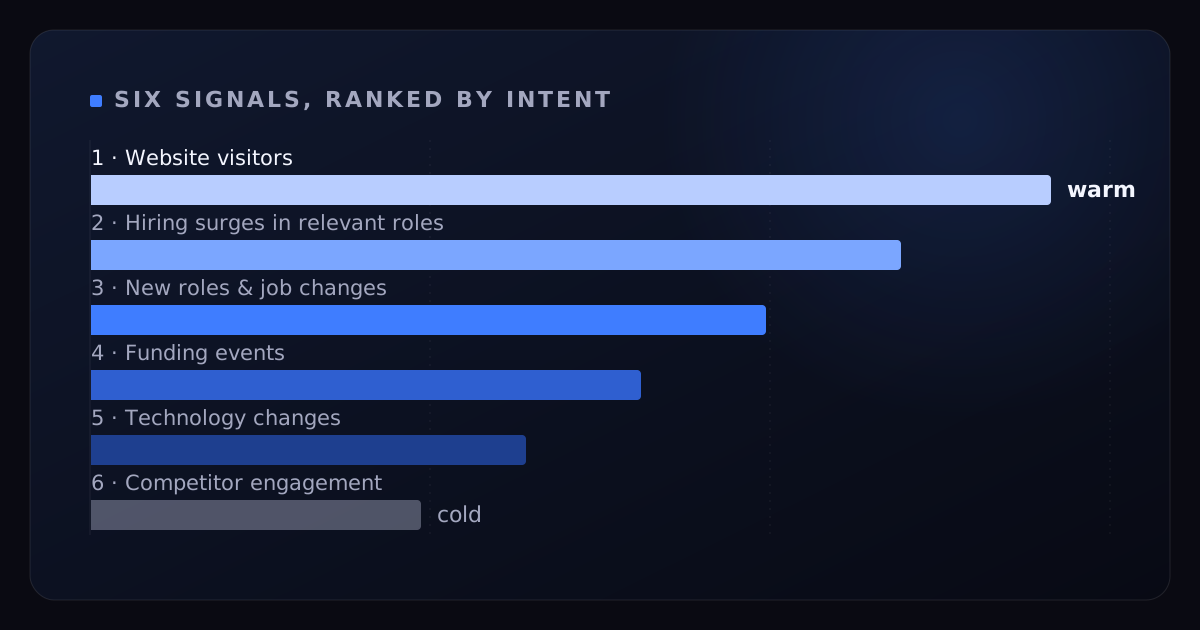
The six signals, ranked by what actually converts
One honesty note first: we won't assign each signal a conversion multiple — those numbers never survive contact with a different ICP, offer, or execution standard. What holds up is the order and the size of the spread: directionally, the gap between rank 1 and rank 6 is the difference between warm and cold outreach.
1. Website visitors — they came to you
The strongest signal on the board, and it isn't close. Someone at a target account visited your pricing page, your case studies, your product pages. They weren't pushed there — they navigated there, which means the problem is live enough that they spent their own time on it. This is inbound intent without the form fill, and it's the closest thing outbound has to a raised hand.
The catch: it's also the most perishable signal on this list. A visitor from three weeks ago is trivia. A visitor from this morning is a conversation.
How do you even get website-visitor data?
The obvious question about the top-ranked signal: where does the data come from, since analytics tools show sessions, not names? The answer is visitor identification: a small script on your site matches each visit against IP and identity graphs. Company-level matching tells you which account is on your pricing page — enough to trigger account-based outreach on its own. Person-level matching resolves a share of visitors to named contacts; it's largely a US practice with real compliance obligations — disclose it in your privacy policy, honor opt-outs, and treat traffic from stricter privacy regimes with caution. Expect partial coverage from any provider; identifying some of your warmest visitors still beats counting all of them anonymously. It's the difference between "traffic was up last week" and "that account read your case studies twice yesterday."
2. Hiring surges in relevant roles — budget plus initiative
When a company opens multiple roles in the function you sell into, two things are simultaneously true: budget has been approved, and an initiative exists that someone is being held accountable for. Nobody posts five job listings for a problem they don't intend to solve. That's what makes hiring the workhorse signal of B2B sales. If your offer accelerates or supports what those hires will do — or does part of it outright — you're walking into a conversation the account is already having internally.
3. New role / job changes — new leaders buy early
A new VP or director spends their first 90 days doing two things: forming an assessment of what's broken, and making moves that prove they were the right hire. New leaders bring their preferred vendors, kill their predecessor's tools, and are unusually open to a sharp outside perspective — precisely because they don't own the status quo. Catch the change within weeks and you're a resource during their evaluation. Catch it at month eight and you're interrupting their roadmap.
4. Funding events — money, but crowded
Fresh capital means real spending ahead, and it's the most public signal on this list — which is exactly the problem. Every SDR team and every agency scrapes the same announcements, and the freshly funded founder gets buried in congratulations-plus-pitch messages the same week the news breaks. The funding signal is real; the channel around it is jammed. It works when your message connects the raise to a specific, researched consequence for that company — and it works better a few weeks later, after the confetti spam has stopped and the actual spending decisions begin.
5. Technology changes — fit, more than timing
An account adopting or dropping a particular tool tells you a lot about whether they're your buyer: their stack, their maturity, their direction. What it tells you less about is when. A tech change is often the tail end of a decision cycle, not the start of one. We treat it primarily as a fit signal — it sharpens targeting and gives outreach something concrete and researched to say — and as a timing signal only when the change clearly creates a gap your offer fills.
6. Competitor engagement — in-market and shopping
Prospects engaging with your competitors — following them, interacting with their content, showing up in their orbit — are doing vendor research in public. The intent is genuine: they have the problem and they're actively evaluating the category. You're just not the default choice, so the outreach has to earn the comparison rather than assume it. Done with respect — no trash-talk, a clear point of difference — it reliably starts conversations with people who were going to buy from someone this quarter.
The signals that don't predict anything
Now the buying-signal examples that fill every vendor list without filling pipeline:
- Third-party topic-intent surges. An intent platform reports that an account is "surging" on your topic, inferred from content consumption across a publisher network. That sounds like a buying signal; it's usually a rumor of one. Someone at a three-thousand-person company read some articles — which someone? A surge fails the signal test twice: no event you can name in a message, no moment you can act on. Corroboration, never a trigger.
- Generic "company growing" flags. Headcount up 12% year over year is a fact, not an event. It names no initiative, no owner, no moment. Outreach built on it reads exactly like what it is: a mail merge wearing a research costume.
- Social follows. Someone followed your company page. That's awareness at its thinnest — a bookmark, not a buying motion. Treat a follow as one input to account scoring if you like; treat it as a trigger and you'll spam your warmest audience.
- Single content downloads. One whitepaper download is the weakest form of engagement that ever earned four automated follow-ups. People download content for a hundred reasons — curiosity, a class assignment, a competitor's intern. A pattern of engagement means something. A single PDF does not.
The common thread: these are audience signals, not buying signals. They describe who might someday care. The six above describe who is likely deciding now. Confusing the two is how teams end up "signal-based" and still cold.
Intent data vs. buying signals
The two terms get used interchangeably; they shouldn't be. Intent data is a data category — mostly third-party, topic-level, inferred. Buying signals are observable events tied to a specific account: a visit, a hire, a raise, a stack change. They overlap — a repeat pricing-page visit is first-party intent data and the strongest signal on this list — but most of what's sold as intent is probabilistic topic interest: useful for prioritization, wrong for triggering a message meant to name a real event. Account, event, moment — buying signals have all three. Topic intent, on a good day, has one.
The freshness rule: a signal is worth what you do with it in hours
Here's the uncomfortable part, and the reason most signal programs underdeliver even with the right signals: the ranking above assumes you act fast. Every one of those six decays — and the strongest ones decay fastest.
A signal is only worth what you do with it in the first hours. Signal plus instant personalized outreach beats signal plus weekly batch — every time, with every signal on the list.
The inbound-lead research makes the same point with hard numbers. The Lead Response Management study — run by InsideSales.com and widely replicated since 2007 — found that reaching a lead within five minutes instead of thirty makes you roughly 21x more likely to qualify them, and that the odds of making contact at all drop about a hundredfold between five and thirty minutes. Those are inbound numbers, but a website visit is the same behavior one step earlier — which is why the speed-to-lead data and this ranking are one lesson at two altitudes.
Most teams run signals like a report: a tool collects events all week, someone exports a list on Friday, and outreach goes out the following Tuesday. By then the website visitor has finished their evaluation, the new VP has taken four discovery calls, and the funded founder has deleted eighty pitches. The team concludes "signals don't work." The signals worked fine. The batch killed them.
A human-operated signal program has a structural lag of days. A wired one has a lag of minutes. No amount of hustle closes that gap — the gap isn't effort, it's architecture, a property of the system rather than the people.
Starting from zero: which signals to wire first
Plenty of teams run zero signals today. If that's you, the order of operations matters more than the tooling:
- Put visitor identification on your site first. It's the highest-intent signal and the fastest to stand up — one script through your tag manager this week. Even company-level matching changes what your outbound can say tomorrow.
- Watch hiring and job changes across your ICP next. Both are public, cheap to monitor, and specific enough to write a real message against. Visitors, hiring, and new leaders together cover interest, budget, and ownership.
- Define one play per signal before adding more signals. Who gets contacted, inside what time window, referencing what, on which channel. A signal without a play is a notification, and notifications get ignored.
- Fix the clock before you scale the volume. Set an SLA from signal to first message in minutes, and make it hold at 11pm on a Saturday — signals don't keep business hours. Then layer in funding events, technology changes, and competitor engagement.
It's also the order a full deployment stages them — the 90-day AI SDR implementation plan walks the arc phase by phase: live pipeline in under 30 days, then days 31–90 compounding what the signals teach you.
Wiring signals to sequences
This is why we build signals as triggers, not reports. In an AiDA deployment, all six signal types — website visitors, hiring surges, new roles, funding events, tech changes, competitor engagement — are wired directly to sequence starts. A signal fires; within minutes the account is enriched and a personalized outreach sequence begins across LinkedIn, email, voice, and SMS — messaging that names the actual event, in your voice, at governed volumes that protect your sending reputation. No export, no Friday list, no Tuesday batch. When the reply comes back it's answered in seconds — real open calendar times offered conversationally, with draft-for-approval wherever you want a human check.
That end-to-end wiring is the difference between owning a signal and reading about one, and a large part of how the systems we run have booked 7,000+ meetings. It's also the piece most overviews of how AI fits into the full sales motion underweight: the model writing the message matters less than the system firing it on time.
So rank your signals honestly. Cut the vanity flags. And then fix the thing that matters more than the ranking: the clock. The best signal in the world, acted on next week, loses to a decent signal acted on this morning.
Frequently asked questions
What are B2B buying signals?
B2B buying signals are observable events — hiring surges, funding events, technology changes, website visitors, new roles and job changes, competitor engagement — that indicate an account is entering a buying cycle. Firmographics describe who a company is; buying signals describe what a company is doing right now. Treat them as triggers for immediate outreach, not rows in a weekly report.
Which buying signals are overrated?
Third-party topic-intent surges, social follows, generic growth flags, and single content downloads. These are audience signals — they describe who might someday care, not who is deciding now — and outreach triggered by them reads like a mail merge. Use them to corroborate stronger signals, never as triggers on their own.
What is signal-based selling?
Signal-based selling means triggering and personalizing outreach off real-time events — a pricing-page visit, a hiring surge, a funding round — instead of working static lists on a quota calendar. The message names the actual event and goes out while it's still fresh. Timing and specificity are the entire advantage; drop either and you're running cold outbound with better branding.
How fast should you act on a buying signal?
Within minutes to hours, not days. Every signal decays, and the strongest — website visitors especially — decay fastest; lead-response research has shown for nearly two decades that qualification odds collapse as the first minutes pass. If your signal-to-first-message lag is measured in days, the batch is erasing the signal's value before you ever use it.