
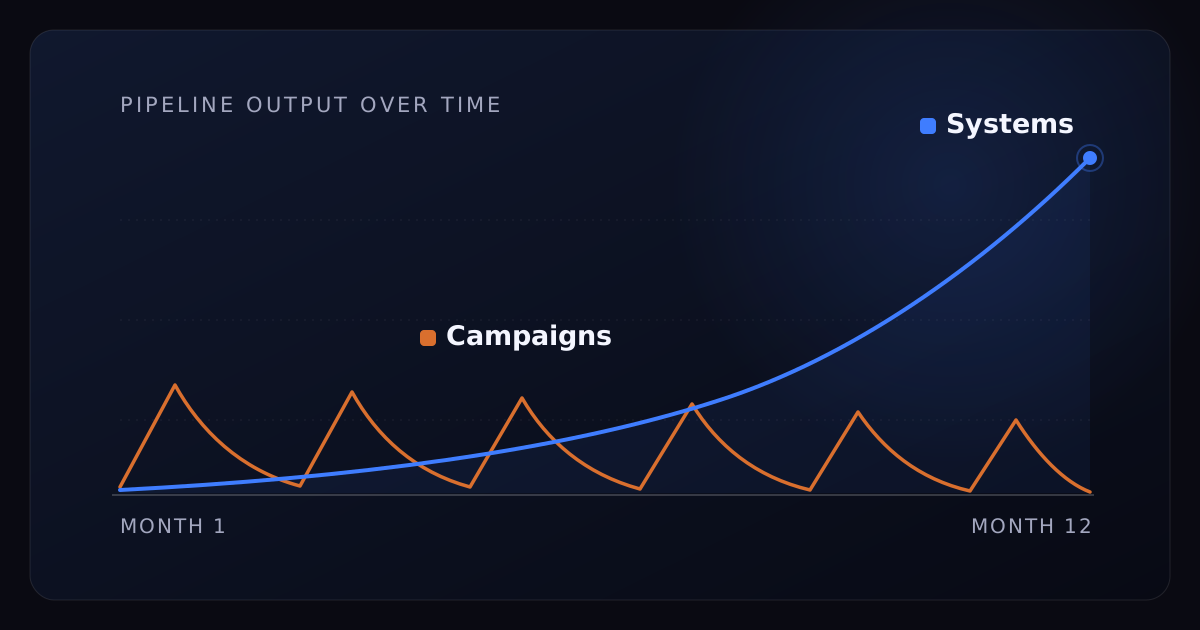
Every dollar you spend on go-to-market buys one of two things: activity or sales infrastructure. Most buyers can't tell them apart at the pitch stage, because both come wrapped in the same language — pipeline, meetings, growth. The difference only shows up months later, usually on the day you stop paying.
Vendors sell activity. We install systems. That's the thesis behind everything we build, and this post is the long version of it: what sales infrastructure actually is, why outbound campaigns stop working no matter who runs them, and the exact questions that reveal which one any vendor — us included — is selling you.
- Campaigns are activity: output stays flat while you pay and resets to zero when you stop. Nothing carries the learning forward.
- Sales infrastructure is an asset: signal monitoring, instant response, and sequencing running on domains and CRM records you own.
- Compounding is mechanical, not magical — every reply sharpens targeting, messaging, and reply handling for the next conversation.
- One question exposes which one a vendor sells: "What do I keep if I fire you tomorrow?"
- Ownership and operation are separate decisions. You can own the system and still have someone else run it.
Why outbound campaigns stop working
Activity is anything a vendor does for you that leaves nothing behind. The classic shapes:
- The campaign. A burst of sends against a list you never see, from domains you don't control, using messaging you didn't approve line by line. It produces some meetings. Then it ends, and so does the pipeline.
- The retainer. A team of appointment setters doing manual outreach every month. Output is roughly flat: month 12 looks like month 2, because nothing they learn is written down anywhere you can use.
- The lead list. Contacts delivered in a spreadsheet, aging from the moment they arrive. Data is a depreciating asset unless something acts on it continuously.
None of this is fraud. Activity produces real output while you pay for it. The problem is the shape of the curve: flat while it runs, zero when it stops. You're renting a treadmill and calling it fitness.
And the expiry is mechanical, not a matter of vendor effort. Lists decay as people change jobs. Copy fatigues as your market sees it for the third time. Domains age badly when they're pushed hard for a quarter and abandoned. A campaign has no mechanism for carrying what it learned into next quarter — which is why the renewal conversation always sounds the same: "we need another quarter to optimize." Of course they do. When nothing carries over, every quarter is quarter one, and you're the one funding the do-over.
What sales infrastructure looks like in practice
Infrastructure is different in kind, not degree. It's a repeatable outbound system trained on your business, wired into your CRM, running on domains and accounts you own — one that gets measurably better with use. Concretely, an outbound sales engine that qualifies as infrastructure looks like this:
- It knows your business, not a template. Your ICP, your offers, your objections and how your best rep answers them — captured once, refined continuously, usable forever.
- It runs on assets you own. Sending domains, sender accounts, CRM records, conversation history. If the relationship ends, the assets stay.
- It works your whole surface area. LinkedIn, email, voice, and SMS — four channels running against the same playbook, feeding the same feedback loop.
- It reacts to the market, not a calendar. Hiring surges, funding events, technology changes, website visitors, new roles and job changes, and competitor engagement — the buying signals that actually predict pipeline start sequences the moment they fire, instead of waiting for next month's batch.
- It answers. Replies handled in seconds, around the clock, with real open calendar times offered conversationally — no booking links — and a draft-for-approval mode wherever you want a human check.
AI is what made this affordable. Always-on signal watching and instant reply handling were enterprise luxuries five years ago; now they're the standard components of the system. Which parts of the motion an AI can own outright — and where humans should stay in the loop — is a longer conversation, and we map it in the operator's guide to AI in sales.
Campaigns vs. systems: the ledger
Here's the same distinction as a ledger. Every line in the campaign column is worth less next quarter than this quarter, and worth nothing the day the contract ends. Every line in the infrastructure column appreciates.
| Asset | The campaign version — expires | The infrastructure version — compounds |
|---|---|---|
| Contact data | A purchased list, aging from the day it arrives | An enriched CRM with full conversation history on every account |
| Sending domains | The vendor's domains — the reputation walks at contract end | Your domains, with deliverability earned month over month |
| Messaging | Copy written once, fatiguing with every send | A library of tested winners, refined against your actual market |
| Learning | The retainer team's tribal knowledge — it leaves when they do | Performance history: which signal, opener, and answer converts |
| Timing | A calendar — sends go out when the campaign says so | Signal triggers that fire the moment an account shows intent |
| Reply coverage | Business hours, when someone's at their desk | Seconds, around the clock, on every channel |
Notice that the compounding column is also the boring column. Nobody screenshots a warm domain. But the boring column is why deployments on this model reach live pipeline in under 30 days and then keep accelerating — the 90-day arc in the 90-day AI SDR implementation plan is really a 30-day launch followed by 60 days of compounding. It's also how we've booked 7,000+ meetings on systems built this way. The exciting-sounding stuff expires. The boring stuff compounds.
Where the compounding actually comes from
Compounding in sales isn't a metaphor borrowed from finance. It's a specific, checkable mechanism: every conversation teaches the system which openers work on which buyers, which objections stall your market, which signals produce meetings versus polite passes — and that learning lands in assets that persist. The messaging library grows a record of tested winners. Targeting sharpens against real replies instead of assumptions. Reply handling gets accurate enough that approval becomes a formality. A campaign forgets everything the day it ends. A system remembers everything and gets sharper.
That mechanism is visible in customer numbers we publish. Legal Podcast Network came to us with burned domains and sub-10 leads a month from email; on owned infrastructure they went to 10 leads a day, and 50% of their deals now come from AiDA. Junk-A-Haulics pointed the same machinery at the database they already had — reactivation, not new acquisition — and got a 5x lower lead cost than buying new. Same markets, same offers. Different asset class.
Activity is an expense that produces output. Infrastructure is an asset that produces output. The invoice looks the same. The balance sheet doesn't.
The diagnostic: five questions to ask any vendor
You can settle the question in one call. Ask these, and don't accept vibes for answers:
- "What do I keep if I fire you tomorrow?" The single sharpest question in the category. If the honest answer is "a report and some memories," you're buying activity. The right answer names assets: your domains, your data, your trained playbook, your conversation history, all in accounts you control.
- "Does month 12 outperform month 2 — and can you show me why?" Compounding leaves evidence: a messaging library of proven winners, targeting sharpened from real replies, reply handling accurate enough that approvals became the exception. Flat output means nothing is learning.
- "Who owns the domains, the data, and the prompts?" Get it in writing. Sending infrastructure in the vendor's name is a leash. Training and messaging you can't export is a hostage situation with a dashboard.
- "What happens to replies at 11pm on a Saturday?" The Harvard Business Review lead-response audit of 2,241 US companies found an average first response of 42 hours — only 37% responded within an hour, and 23% never responded at all. Infrastructure answers in seconds, every time; the speed-to-lead data makes the full case. Activity answers Monday morning, if the retainer covers weekends.
- "How does volume get governed?" A system protects the assets it runs on — governed sending volumes, warm-up, deliverability discipline. A campaign shop burns your domains chasing this month's number, because next month is your problem.
A vendor selling real infrastructure will answer all five without flinching. A vendor selling activity will change the subject to how many meetings they booked last quarter.
Own the system, rent the labor
The obvious objection: "If I own the infrastructure, don't I have to run it?" No — and this is the part most of the market gets backwards. Ownership and operation are separate questions.
The model we run: you own it, we operate it, it compounds. The domains, the data, the trained playbook, the CRM records — yours, from day one, in your accounts. The operating — list building, sequencing, reply handling, weekly tuning, governance — ours. You get the output of a full outbound team and the asset value of a system, without hiring either. That's the model behind everything we deploy.
That alignment changes vendor behavior in ways you can verify. When the vendor operates assets the client owns, burning a domain is burning the client's property. Flat month-12 performance is visible in the client's own CRM. There's nowhere to hide a treadmill.
One more thing. This post is half of an argument: what sales infrastructure is, and why it compounds. The other half is who should own it — the full ownership inventory, what to demand in the contract, and how to take the system with you if you ever leave. That half lives in the case for owning your outbound. Read them together and you have a complete filter for any vendor conversation.
So before you sign anything — with us or anyone — run the diagnostic. Ask what you keep. Ask what month 12 looks like. Ask who owns the domains, the data, and the prompts. The vendors selling activity will hate the questions.
The ones selling infrastructure will have been waiting for someone to ask.
Frequently asked questions
What is sales infrastructure?
Sales infrastructure is the permanent system underneath a revenue motion — signal monitoring, routing, instant response, sequencing, and the data layer that connects them — running on assets the company owns. It keeps producing pipeline independent of any one campaign, vendor, or rep, and it improves with use instead of expiring.
Why do outbound campaigns stop working?
Because campaigns are activity, not process: lists decay, copy fatigues, and domains age, so output flattens even while you're paying. When the campaign ends, results reset to zero — nothing carries the learning forward into whatever you run next.
What is the difference between a campaign and a system?
A campaign has an end date and expiring assets; a system runs continuously and accumulates them. A system captures what every conversation teaches — which openers work, which objections stall, which signals convert — so it gets cheaper per meeting over time instead of resetting to quarter one.
How do you build a repeatable outbound system?
Own the ICP definition, wire always-on buying-signal triggers to sequence starts, standardize your sequences and response SLAs, and review the feedback loop every 4–6 weeks. The critical property is that the learning lands in assets you control — your CRM, your messaging library, your domains — not in a vendor's head or dashboard.
What does compounding mean in sales?
Compounding means each conversation, reply, and data point improves targeting and copy for the next one — so month 12 outperforms month 1 without more spend. It's the property that separates infrastructure from activity: a campaign produces output, a system produces output plus a sharper system.