"Should we do AI calling or AI texting?" comes up on almost every strategy call, usually framed as a budget decision — pick one, fund it, see what happens. After running both channels across a lot of deployments, we can tell you the framing is wrong. But the underlying question — which channel wins for which lead — has real, observable answers.
A note on data before we start. Most AI calling vs. AI texting comparisons quote response-rate tables with suspicious precision and no methodology. We're not going to hand you fake-precise percentages. We'll use the few public numbers that hold up — SMS open rates commonly reported around 98%, the unambiguous lead-response research on speed — and for everything else, what we consistently see in live deployments, and why.
The short version: voice wins on bandwidth, text wins on permission, and the winning motion runs both as one conversation.
- Voice is the bandwidth channel — fastest qualification, highest trust. Text is the permission channel — it gets answered when a call can't land.
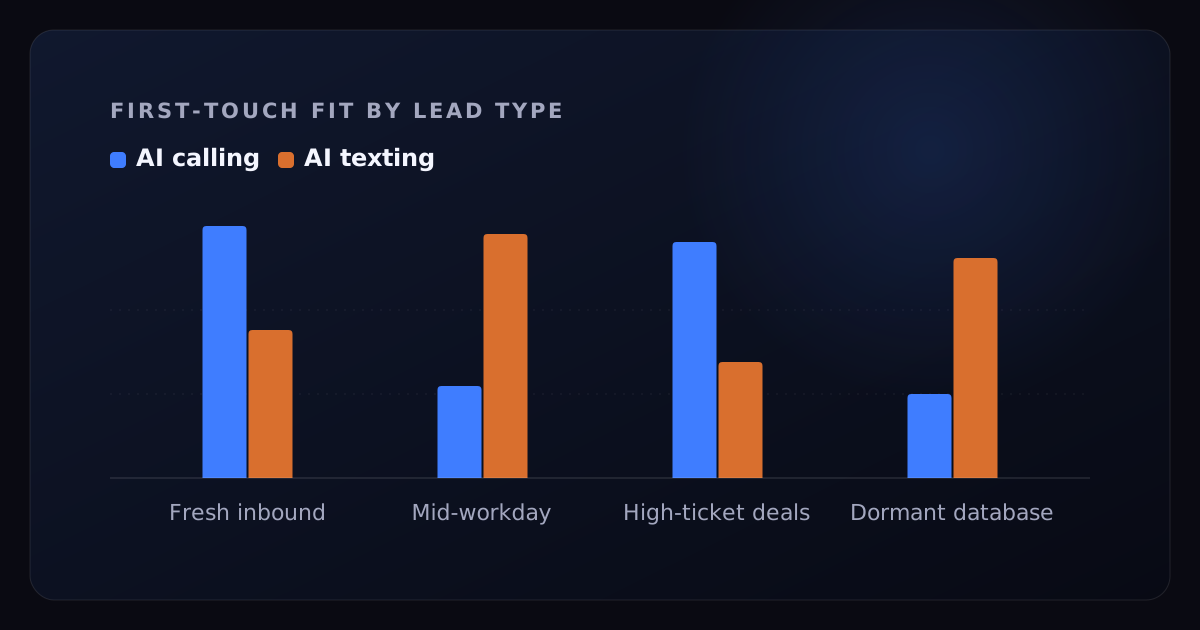
- Route by lead type: fresh hand-raisers and high-ticket deals get a call within minutes; mid-workday prospects, digital-first buyers, and dormant databases get text-led sequences.
- The public data argues urgency, not channel superiority: roughly 21x better qualification odds contacting within 5 minutes vs. 30; SMS open rates commonly reported around 98%.
- The best motion is sequencing — a text announces the call, a missed call becomes an open thread, and each lead's behavior overrides the default.
- Compliance is architecture, not training: consent records, quiet hours, 10DLC registration, and AI-call disclosure belong in the system itself.
Which channel wins by lead type: the decision table
If you take one thing from this post, take the table — the routing logic we install, compressed:
| Lead type | First channel | Why |
|---|---|---|
| Fresh inbound hand-raiser (form fill, demo request) | Call within minutes, announced by a text | Intent peaks right now; a live conversation qualifies and books on the spot. |
| Mid-workday B2B prospect | Text | Unreachable by phone from nine to five — but answers texts from inside meetings. |
| High-ticket, relationship-driven deal | Call | Trust is the product; a real conversation signals seriousness a text can't. |
| Traditional industry (construction, insurance, legal, home services) | Call | The phone is still the default business instrument; a text from an unknown number reads as spam. |
| Digital-first buyer (SaaS, e-commerce, media, agencies) | Text | An unexpected call is an intrusion; text is the native register. |
| Complex qualification (budget, timeline, technical fit) | Call | Branching conversations favor the fastest round-trip. |
| Scheduling and confirmations | Text | Logistics belong on the lowest-friction channel. |
| Dormant database re-engagement | Text first, voice on reply | A call after months of silence feels like pressure; a short text is a low-stakes re-open. |
Two caveats. "First channel" means the opening move, not the whole play — nearly every row goes multi-channel within a day. And every row assumes speed: the right channel chosen slowly loses to the wrong channel chosen in seconds.
When AI calling wins
Voice is the highest-bandwidth channel in outbound. A two-minute conversation covers what a fifteen-message text thread can't — it's why AI voice agents earn their keep on lead qualification. Voice earns the first touch in four situations:
- The lead just raised their hand. Someone fills out your form and their intent is peaking right now. A call that lands within minutes catches them in that window; a call the next morning reaches a different person — colder, busier, already talking to your competitor. The InsideSales.com Lead Response Management study — replicated repeatedly since 2007 — is blunt about the window: contact within five minutes rather than thirty and you're roughly 21x more likely to qualify the lead, while the odds of making contact at all collapse about 100x across the same gap (we broke down the full speed-to-lead statistics separately). This is the single strongest case for AI voice, because a machine actually answers in seconds, every time, 8pm on a Friday included.
- High-ticket, relationship-driven sales. When the deal is large and trust is the product, a real conversation signals seriousness in a way a text can't — buyers making big decisions want to hear how you handle their questions.
- Older and traditional industries. Construction, insurance, legal, home services, manufacturing — markets where the phone is still the default business instrument. There, a call reads as professional; a text from an unknown number reads as spam.
- Complex qualification. If qualifying takes genuine back-and-forth — budget, timeline, decision process, technical fit — voice resolves in one exchange what text drags across two days. Branching conversations favor the channel with the fastest round-trip.
When AI texting wins
Text wins on a different axis: not bandwidth, but permission. Treat the widely reported ~98% SMS open-rate figure as directional — but the direction is real: almost everyone reads almost every text, usually within minutes. It's the channel people answer when they can't — or won't — answer anything else:
- The prospect is mid-workday. Most of your leads are unreachable by phone from nine to five, not because they're avoiding you, but because they're in meetings. Those same people answer texts from inside those meetings. Text is the only channel that works while your prospect is busy.
- Younger buyers and digital-first industries. For a large and growing share of the market, an unexpected phone call is an intrusion and a text is normal. SaaS, e-commerce, media, agencies — text-first is the native register.
- Simple confirmations and scheduling. "Does Tuesday at 2 or Thursday at 10 work better?" doesn't need a phone call. Logistics belong on the lowest-friction channel, and nothing beats a text a prospect can answer in four seconds.
- Re-engaging dormant leads. A call to someone who went quiet three months ago feels like pressure. A short, well-timed text is a low-stakes re-open they can answer without committing to anything. This is the backbone of database reactivation, and it's why our reactivation deployments lead with AI SMS follow-up rather than calls. The economics get silly: Junk-A-Haulics ran a reactivation on leads already in their CRM and cut lead cost by 5x — no new ad spend.
The time-of-day pattern (and the 42-hour problem)
The channels also live on different clocks. Calls connect during business hours — mid-morning and mid-to-late afternoon are reliably the best windows, and the post-lunch slump is reliably the worst. The pattern tracks calendar rhythms: mid-morning, people are at their desks but not yet buried; late afternoon, meetings thin out and the phone becomes answerable again. Outside business hours, calling mostly stops making sense.
Text doesn't share the constraint. Replies cluster at the edges of the day — early morning before the calendar fills, evenings after it empties — exactly the hours when a call would go unanswered or land badly. A meaningful slice of text conversations happens when no SDR is at a desk — which is where a system that responds in seconds, 24/7, earns its keep.
Now put those clocks next to the market's actual behavior. The Harvard Business Review lead-response audit of 2,241 US companies found the average first response to an inbound lead took 42 hours. Only 37% responded within an hour; 23% never responded at all. Whatever window your lead's day opens — 7am, lunch, 9pm — the average competitor isn't in it. An AI system that answers in seconds on the channel that fits the hour is competing against a 42-hour baseline. It's not a fair fight, which is rather the point.
Compliance: TCPA, quiet hours, 10DLC, and AI disclosure
Outbound calling and texting are regulated channels, and the rules have teeth. In the US, the TCPA and its state-level equivalents govern both: you need consent you can prove, quiet hours honored automatically, and opt-outs processed instantly — not "flagged for the team," processed. We're not offering legal advice; we're telling you that in a well-built system these live in the software, not in a training doc.
Texting has an additional operational gate almost every buyer discovers late: A2P 10DLC registration. US carriers require businesses to register their brand and campaign type before sending application-to-person SMS at volume; unregistered traffic gets filtered or blocked outright, and approval takes days to weeks. If SMS is in your plan, 10DLC belongs in week one of the deployment, not the week you meant to launch.
Then there's the disclosure question, which is settled enough to build around: the FCC has made clear that AI-generated voices count as "artificial" under the TCPA, and states are layering on their own disclosure requirements for AI calls. Our position is simple — build the system so it never needs to hide what it is. Clean consent records, governed volumes, and a human in the loop on anything sensitive aren't just compliance; they're why the channel still works after your competitors burn it.
The real answer: voice AI and SMS together, in sequence
Here's where the "which channel" debate falls apart: in live deployments the best-performing motion is almost never one channel — it's channels in sequence, each doing what it's best at:
- Text, then call. A short text announces the call — "Just saw your request, calling you in a minute" — so the ring arrives expected instead of cold. Answer rates on announced calls are visibly better than on cold ones.
- Call, then voicemail, then text. No answer isn't a dead end. A voicemail plus an immediate text turns a missed call into an open thread the prospect can answer on their own terms.
- Adapt per lead. This is the part a human team can't do at scale and an AI system does natively: read the response pattern and follow it. The lead who never picks up but texts back within a minute gets a text-led sequence. The lead who answers on the first ring gets voice. The channel decision stops being a strategy-deck debate and becomes a per-lead adaptation.
Stop asking which channel your market prefers. Run both, and let each lead show you — their behavior answers the question better than any survey will.
One design rule is non-negotiable in our deployments: when a lead is ready to meet, the AI offers real open times from your reps' calendars, conversationally — "Would Tuesday at 2 or Wednesday at 10 work?" — never a booking link. Links add friction and feel like homework; a conversational close keeps the momentum. And when a lead is hot on a live call, they don't get scheduled at all — they get warm-transferred straight to a closer.
The SLA is the strategy
Zoom out and the channel debate reveals itself as a distraction. Across everything we've deployed — voice and SMS, with the LinkedIn sequences and email cadences running alongside them — the variables that actually move booked meetings are the same three, regardless of channel:
- Be first. Speed to lead dominates. Replies answered in seconds beat perfect messaging delivered hours later, on any channel.
- Be relevant. Reference what they actually did — the form they filled, the signal that fired, the question they asked.
- Be easy to book. Offer times, not links. Remove every step between "interested" and "on the calendar."
Teams that nail those three win on whichever channel they run. Teams that miss them lose on both. It's a large part of how the AI SDR system behind this has booked 7,000+ meetings: not by picking the right channel, but by being first, relevant, and easy to book on every channel a lead prefers — LinkedIn, email, voice, and SMS, wired into one system.
Vendors sell channels. We install the SLA.
Frequently asked questions
Is AI calling or AI texting better for lead follow-up?
Neither wins across the board. Texting wins on reach — SMS open rates are commonly reported around 98% — while voice wins on qualification depth and trust. Route by lead type: fresh, high-intent inbound leads get a call within minutes; mid-workday prospects, digital-first buyers, and dormant databases get text-led sequences.
When should an AI voice agent call a lead?
The moment a high-intent lead raises their hand — a demo request, a pricing form, a call-back request — and inside the five-minute window. The InsideSales.com Lead Response Management study shows contacting a lead within five minutes rather than thirty makes you roughly 21x more likely to qualify them, and a live two-way conversation can qualify and book on the spot.
Can AI actually qualify leads over text?
Yes. A well-built AI SMS agent reads each reply, asks qualifying questions in sequence, handles objections, and offers real calendar times conversationally — in seconds, at any hour. What text gives up in bandwidth it recovers in persistence: the conversation resumes whenever the lead picks their phone back up.
What are the compliance rules for AI calls and texts?
Both channels sit under the TCPA and state-level equivalents: provable consent, honored quiet hours, and instant opt-out processing. US business texting also requires A2P 10DLC registration with carriers before you can send at volume, and the FCC has made clear that AI-generated voices count as artificial voices under the TCPA. This isn't legal advice — but a well-built system enforces all of it automatically.
Should you combine AI calling and texting?
Yes — sequencing both channels outperforms either alone in nearly every deployment we've run. The strongest patterns are a text that announces the call, so the ring arrives expected, and a call-voicemail-text chain that turns a missed call into an open thread. Then let each lead's response behavior override the default channel.